:::::::::::::::::::::::::::::::::::::::::::::::::::::::::::::::::::::::::::::::::::::::::::::::::::::
Grave (haka)
***** Location: Japan, Worldwide
***** Season: Non-seasonal Topic, kigo see below
***** Category: Humanity
*****************************
Explanation
A place where we all end up eventually. With many cultural diversifications.
GRAVE, graves itself is not a kigo, but it comes in various words related to the Bon Festival in early Autumn
graveyard, cemetery
funeral 葬式 sooshiki, 葬儀 soogi,
告別式 soobetsushiki;葬列 sooretsu
. sooshiki 葬式 soshiki - funeral service in Edo .
hayaokeya, hayaoke ya 早桶屋 "fast coffin maker" , undertaker
soogiya 葬儀屋 / saihooya 西方 / koshiya 輿屋 = undertaker
. ishibitsu, sekibitsu 石櫃と伝説 Legends about stone coffins .
.................................................................................

observance kigo for autumn
visiting the ancestor's graves, visiting the graves
... hakamairi, haka mairi 墓参 (はかまいり)
bonsan 盆参 (ぼさん) visiting the ancestor's graves in preparation for O-Bon
grave visiting
..... haka moode, hakamoode 墓詣(はかもうで)
cleaning the grave, especially the weeds
....tenboo 展墓 (てんぼ)
scrubbing off the moss from the graves, sootai 掃苔 (そうたい)
cleaning the graves, haka sooji 墓掃除 (はかそうじ)
washing the grave stones, haka arau 墓洗う (はかあらう)
O-Bon Festival in Japan お盆
.................................................................................
observance kigo for the New Year
juurokunichi sai 十六日祭 (じゅうろくにちさい)
festival of the 16th day
mii juukokunichi 新十六日(みいじゅうろくにち)
new 16th day
koodooroo 香燈籠(こうどうろう)fragrant lanterns
This refers to a custom of Okinawa.
Families which had a death in the past year wait until the 16th day of the New Year to visit the graves of their ancesters. They offer ricecakes and food and partake of it themselves later in a family feast. They also burn paper money and offer fragrant lanterns.
These lanterns may be round or with four or more corners. They have auspicious patterns and are placed under sprial incense coils to become fragrant. They are placed on the grave and let there to their fate in wind and rain, as an expression of the aware of human life.
SAIJIKI – NEW YEAR OBSERVANCES
.......................................................................
- quote -
The History of Cremation in Japan
As Buddhism spread through eastern Asia during the first two millennia AD, so did the practice of cremation. Death created pollution, people believed, and the ritual disposal of bodies was supposed to be cleansing. Until the last few years of the 19th century, cremation was controversial in Japan because a portion of the population—Confucians, specifically—believed the burning of corpses to be morally indefensible and more polluting than full-body burial. Although Buddhism propelled cremation’s spread across Asia, its staying power, particularly in Japan, has been for practical reasons. This is the story of how Japan came to have the world’s highest rate of cremation.

Two important deaths in quick succession launched Japan’s cremation movement: that of Dosho, a Buddhist priest, in 700 AD, and Emperor Jito in 703. The emperor’s cremation was particularly influential, and it set a precedent Japanese aristocracy would follow for centuries.
However, it was not until the end of the Heian period (794-1185), which began shortly after Dosho and Jito’s corpses were burned, that cremation became closely associated with Buddhism in Japan. Buddhist philosophy teaches that everything—including life and the body—is impermanent, and that the cleansing fire of cremation is transformative. Cremation helps to disperse “pollution” created after a person dies and to move the spirit into the ancestral realm—from a “polluting spirit” to a “purified ancestral spirit,” as scholar Masao Fujii wrote. During the Kamakura period (1192-1333), the practice of cremation spread from the aristocracy to the people.
In 142 years, there arose in Japan a vocal antagonist to cremation: Confucians. Confucians viewed cremation as disrespectful to the dead and “unnatural”—and the fact that it was a Buddhist practice didn’t help. Buddhists or Buddhist temples owned and ran most of the crematoria throughout Japan and China, and as a result, cremation was seen inextricably as a Buddhist practice. A Confucian scholar living in the 17th century demeaned cremation’s use throughout more than 60 of Japan’s provinces.
In 1654, nearly a thousand years after Jito was cremated, Japanese aristocracy ended the cremation streak: Emperor Gokomyo’s body was buried instead of being burned. By this time, Confucian scholars, the most vocal opponents to the practice, were firmly entrenched in Japan’s elite class.
The conflict over cremation came to a head in the late 19th century. In 1868, Emperor Meiji took the throne and began transforming Japan into a modern nation-state. This period, which became known as the Meiji Restoration, was marked by dramatic social and political reform, including the abandonment of feudalism in exchange for a capital economy. “In the eyes of many Meiji bureaucrats, anything ‘Buddhist’ was incompatible with ‘civilization,’” scholar Andrew Bernstein wrote in “Fire and Earth: The Forging of Modern Cremation in Meiji Japan.”
In the late 1860s, government officials made several failed attempts to ban cremation. They found their first real opportunity in early 1873, when Tokyo’s police requested that the government order crematoria to move outside “the red line” surrounding the city, calling the smoke from dead bodies damaging to the public’s health. On July 18, 1873, despite public opposition, Japan banned cremation. To justify it, government officials claimed that burning bodies was disrespectful to the dead and jeopardized public morality and that the resulting smoke was, Tokyo’s police claimed, a public health concern.
Opponents focused on undeniable problems the ban caused: Full bodies took up space faster than ashes; separating ancestral remains was a moral and emotional hardship for families; and cremation was actually more sanitary than in-ground burial because, particularly during disease epidemics, fire was the only sure way to kill contagions.
The conflict played out in urban areas where the law was easier to enforce and had the biggest and most immediate negative effect on residents. Japan’s increasing urbanization in the late 19th century meant cities had denser populations, putting pressure on the limited land available in temple cemeteries. Some families chose to keep their relatives’ ashes at home, but for the most part, they placed ashes in family plots. Because the ashes of a single person take up so little room, families had been able to inter generations of their ancestors’ ashes together using relatively little land. As space ran out in the cities, families began burying their loved ones outside of city limits, making it harder for city dwellers to visit their dead relatives’ remains. Especially given the government’s claim that cremation would corrupt Japan’s moral center, the disruption the ban caused was a slap in the face to the Japanese people: Family is sacred in Japanese culture. With limited space to bury bodies and a dense population that overwhelmingly opposed the ban, something had to give.
At the same time, scientific researchers in Europe touted the sanitary benefits of cremation, including its use in helping control the spread of disease. And so, opponents of Japan’s ban framed Europe’s growing interest in cremation as approval from the West, rejecting the claim that it created more pollution than burial and, effectively, in the minds of the government, separating cremation from Buddhism. Rather than a spiritual practice, people came to view it as a sanitary one.
In May 1875, less than two years after it passed, the ban was reversed. Two decades later, in 1897, the Japanese government ruled that anyone who died of a communicable disease had to be cremated. In an ironic twist, government officials began actively promoting the cleansing power of fire and its ability to destroy diseases.
In the 1890s, Japan’s cremation rate hovered around 40 percent, gaining or losing a couple points year after year. It wasn’t until 1930 that it surpassed 50 percent. From 1950 to 1980, the rate increased from 54 percent to 91.1 percent, and it has only continued to climb.
Confucians weren’t, of course, cremation’s only opponents on moral or religious grounds. Elsewhere in the world, the Catholic Church, up until 1964, banned cremation for its adherents. In-ground burial was mandated in the hopes that, like the body of Christ, the deceased’s body might be resurrected. But mainly the Church instituted the ban because cremation, which was seen as a rejection of the possibility of Christ’s resurrection, had been practiced as a form of protest against the Church as recently as the late 19th century.
As in Japan, the Church ultimately reversed its doctrine for practical reasons: Officials recognized cremation’s public health and economic merits. And they understood that people chose cremation for private reasons, including a desire to keep family members’ remains close.
As long-distance travel became easier in the 20th century, families dispersed around the world, which meant ancestors’ buried remains stayed behind. The Cremation Association of North America attributes the increase in cremation in part to wanting to bring along a loved one’s remains. As the century progressed, another change took place: Cities around the world blossomed in size, putting pressure on limited cemetery land within city bounds. Cremation has made it possible to fit more remains in the same limited space.
Over the past century, and primarily after the Second World War, traditions in Japan, like so many places in the world, have changed. Cremation, which was previously seen as a Buddhist practice, has now become a secular, nation-wide tradition. Buddhist practice in Japan, too, has relaxed: Traditionally, in Buddhist funerals, the whole family had to be present at the cremation of a body. The period of mourning began at cremation and lasted 49 days, after which the deceased’s spirit was said to be with ancestral spirits. Now, instead of observing the death day of a loved one for decades, most families stop after a few years.
Decoupling Buddhism and cremation has resulted in another change: In the place of priests, funeral cooperatives and then funeral directors and undertakers ultimately took over corpse disposal and ceremonies for the dead. Cooperatives did business locally, servicing a neighborhood. Tokoro’s first undertaker opened for business in 1963.
Although traditions have changed, cremation has endured. The Japanese government’s ban in the 1870s forced a conversation about the pitfalls and merits of burning bodies over other forms of final disposition. In the late 19th century, cremation transformed from a spiritual practice to a practical one, and for those practical reasons cremation has earned Japan’s total embrace.
J. M. W. Silver. Licensed under Public Domain via Wikimedia Commons
- source : jstor.org/history-japan-cremation -
*****************************
Worldwide use
List of Famous Graves
:::::::::::::::::::::::::::::::::::::::::::::::::::::::::::::::::::::::::::::::::::::::::::::::::::::
Belgium
Yesterday, I had a day off and cycled to have a look at the cemetery belonging to the commune of Saint-Josse, the part of Brussels where I live. The Brussels cemeteries are all quite famous and pride themselves on their fine buildings, parks and graves. That of Saint-Josse is among the less-known ones, and indeed the commune of Saint-Josse itself is the smallest of Brussels.
The very first thing I saw after entering the gates of the cemetery, was a wide expanse of war graves to my left -- something I had not expected at all. I had come with my haiku book and my camera, in the warm sunshine (itself also unexpected!), and settled down to take some pictures. As I decided on which angle to use, the sun
disappeared behind a large cloud.
war cemetery --
waiting for the sunshine
to return
That was the moment -- and that was also the deeper feeling.
Here are some photos, in case anyone is interested :
. PHOTO ALBUM ISABELLE
We are very lucky in Europe to have seen no more war since these graves were created... As someone who has lived during most of the years of European construction and the creation of European unity, I am thankful for the work put in by so many.
Isabelle Prondzynski August 2008
:::::::::::::::::::::::::::::::::::::::::::::::::::::::::::::::::::::::::::::::::::::::::::::::::::::
Egypt
Pyramids, the Graves of the Pharaos
:::::::::::::::::::::::::::::::::::::::::::::::::::::::::::::::::::::::::::::::::::::::::::::::::::::
Germany
Grab, Friedhof, Beerdigung
:::::::::::::::::::::::::::::::::::::::::::::::::::::::::::::::::::::::::::::::::::::::::::::::::::::
India
. The burning ghats - Benares, Varanasi
The best season to visit there is autumn.
*****************************
Things found on the way
Graveyard for Haiku Poets : Haijin Bochi
竜が丘俳人墓地 (たつがおかはいじんぼち)
at Tatsugaoka in Shiga prefecture

Graves and haiku memorial stones of 17 haiku poets.
Mizuta Masahide 水田 正秀
Naito Joso 内藤丈草
Choo Mu 蝶 夢
Hajoo 巴静
Moriya Yuushoo 森谷祐昌
:::::::::::::::::::::::::::::::::::::::::::::::::::::::::::::::::::::::::::::::::::::::::::::::::::::
funeral parade -
black robes wandering
through the white snow
Gabi Greve
For Grandmother Stonefield
and the rural funeral rites of Japan
:::::::::::::::::::::::::::::::::::::::::::::::::::::::::::::::::::::::::::::::::::::::::::::::::::::
jumokuso 樹木葬 funerals under trees

'Japanese Tree Burial: Ecology, Kinship and the Culture of Death'
Author: Sébastien Penmellen Boret
Reviewed by Mark McGuire (John Abbott College)
. Japanese Tree Burial .
********************************
HAIKU
...................................... Some haiku by Gabi Greve
graves of the unknown -
pilgrims faces faded
into stone
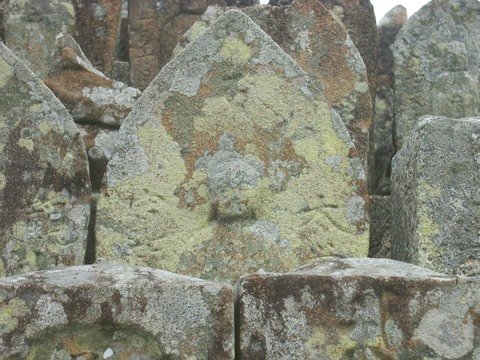
Pilgrims in Shikoku
ooo ooo ooo ooo ooo ooo ooo ooo ooo
秋彼岸 あそこの墓も花のなき
aki higan asoko no haka mo hana no naki
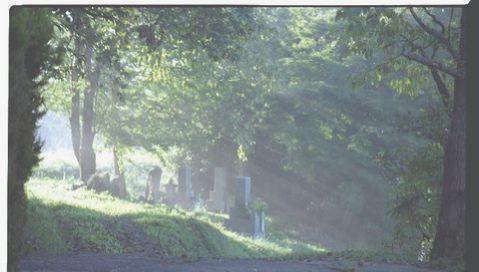
autumn equinox -
so many gravestones
without flowers
I have written a bit more on the rural Japanese family graves here:
Lonely Graves in Morning Mist
ooo ooo ooo ooo ooo ooo ooo ooo ooo
lonely graves
spooking away the ghosts -
Summer in Japan

Ghost Stories, by Gabi Greve
:::::::::::::::::::::::::::::::::::::::::::::::::::::::::::::::::::::::::::::::::::::::::::::::::::::
- - - - - Matsuo Basho - - - - -
瓜の皮剥いたところや蓮台野
uri no kawa muita tokoro ya Rendaino
we had just peeled
the skin of the melons -
Rendaino cemetery
Rendaino was a famous graveyard in Kyoto, near Mount Funaokayama 船岡山.
The word is also used for graveyards elsewhere.
The haikai meeting of Basho and his companions was probably held there, the topic for the event was "a famous place for melons". After spending some time and eating all the melons, Basho was stuck in the present situation - back here at the cemetery.
Written in the summer of 1694 元禄7年夏.

rendai 蓮台 is a pedestal in the form of a lotos, which Kannon Bosatsu carries to welcome the souls of the dead in the Buddhist paradise.
. Matsuo Basho 松尾芭蕉 - Archives of the WKD .
. WKD : hasu 蓮 renge 蓮華 .
:::::::::::::::::::::::::::::::::::::::::::::::::::::::::::::::::::::::::::::::::::::::::::::::::::::
. Kobayashi Issa 小林一茶 in Edo .

source : pochi21.exblog.jp
我死なば墓守となれきりぎりす
ware shinaba hakamori to nare kirigirisu
when I die
guard my grave
katydid!
Tr. David Lanoue
when I am gone
guard my gravestone,
cricket
Tr. Michael Haldane
- - - - -
末の子や御墓参りの箒持
sue no ko ya o-haka mairi no hooki mochi
the youngest child
on the grave visit
brings the broom
Tr. David Lanoue
- - - - -
墓の木の陰法師ふまぬ角力哉
haka no ki no kageboshi fumanu sumoo kana
the sumo wrestler
steps around the shadow
of the tree by the grave
Kobayashi Issa 一茶
Comment by Chris Drake:
Normally people get out of the way when a large, muscular sumo wrestler walks by, but Issa shows how timid one wrestler is. The long shadow of a tree near a grave falls across part of the road, and when the wrestler reaches the spot he avoids stepping on the shadow as carefully as he would avoid stepping on another person or animal. He seems to believe stepping on the shadow would be as bad as stepping on the grave itself, and, apparently feeling a mixture of fear of ghostly retribution and respect for the dead person, he walks around the shadow without stepping on it.
I found several references to a folk belief according to which it is considered unlucky if a large tree is growing near a grave and therefore that graves should be placed some distance from the nearest big tree. (This belief is not universal, but it is common.) This may be because trees, especially pines and willows, were and sometimes still are associated with ghosts and spirits returning from the other world. This may be partly linked to the tendency in Japanese (and Siberian) shamanism to regard trees as symbols of the "ladders" shamans climb when they go into a trance and are believed to visit other worlds. The pine tree depicted on one wall of noh stages expresses this belief, and in Japanese the counter suffix for gods is -hashira, "pillar" or "pole," so two gods are literally "two god-poles" (futa-hashira no kami), and thee poles is used for three gods, etc. So the sumo wrestler may consider the tree to be a possible link or connection point between the grave and the other world, and he wants to avoid being haunted or bothered by any ghosts or spectral presences, especially the soul of the buried person.
One other possibility, less likely, is that ki or "tree; wood" here refers to the wooden pole, carved like a small stupa at the top, that often stood by a commoner's grave in place of a gravestone, especially in the countryside. It is a custom that no longer seems to be followed in Japan.
:::::::::::::::::::::::::::::::::::::::::::::::::::::::::::::::::::::::::::::::::::::::::::::::::::::
朝寒やひとり墓前にうづくまる
asazamu ya hitori bozen ni uzukumaru
cold morning -
alone I stay bent
in front of a grave
Masaoka Shiki 正岡子規
:::::::::::::::::::::::::::::::::::::::::::::::::::::::::::::::::::::::::::::::::::::::::::::::::::::
In Memoriam Erika Schwalm, 17 December 2005
Let thousand ikebana
decorate your grave
and a haiku-string.
Judit Vihar (Hungary)
visiting the dog's grave
then away!
grasshopper
David G. Lanoue(USA)
http://www.worldhaiku.net/news_files/others/deathnoticeerika.htm
:::::::::::::::::::::::::::::::::::::::::::::::::::::::::::::::::::::::::::::::::::::::::::::::::::::
tempslibres : Mot-clé / Keyword : mort / death
Mother's Day;
the smell of roses
near a grave.
Fête des mères;
le parfum des roses
près d'une tombe.
Ann Krischus , USA
new gravesite
the persistent taps
of a woodpecker
nouveau cimetière
les coups persistants
d'un pic-vert
Cindy Tebo , USA
grandfather's grave
just another stone
for the dragonfly
la tombe de grand-père
juste une autre pierre
pour la libellule
Cindy Tebo , USA
kiri saite
suterare mura ni
haka nokoru
Paulownia flowering
in the forgotten village
only graves are left
Paulowniablueten
im verlassenen Dorf
nur noch Graeber
Paulownia en fleurs
dans le village oublié
seules les tombes sont restées
Gabi Greve , Japan
fading light -
a red leaf bouquet
at the smallest grave
la lumière décline --
un bouquet de feuilles rouges
sur la plus petite tombe
Mary King , USA
I light on again
the candle on her grave
extuinguished by wind
j'allume à nouveau
sur sa tombe la bougie
éteinte par le vent
Tomislav Maretic/ , Croatia
tempslibres : Mot-clé / Keyword : mort / death
:::::::::::::::::::::::::::::::::::::::::::::::::::::::::::::::::::::::::::::::::::::::::::::::::::::
rise up
from the grave, bonifacio...
summer is near
robert wilson
Bonifacio Day, Philippines World Kigo Database
xxxxxxxxxxxxxxxxxxxxxxxxxxxxx
staro groblje -
miris majčine dušice
u lahoru
old graveyard -
a scent of wild thyme
on the breeze
Norman Darlington
"First published in Daily Yomiuri 2004"
xxxxxxxxxxxxxxxxxxxxxxxxxxxxx
the new graveyard
slowly the cleared field
regains its stones
published in "Modern Haiku," Vol. X, No. 3, p. 7
(This was written on a trip to Ireland, as my wife and I bicycled past the place mentioned, near the town of Dingle.)
Larry Bole
:::::::::::::::::::::::::::::::::::::::::::::::::::::::::::::::::::::::::::::::::::::::::::::::::::::
うすものに風あつまりて葬了る
usumono ni kaze atsumarite so owaru
a breeze is gathering
in our thin kimonos -
the funeral is over
Hasegawa Sogyo (Hasegawa Soogyo)
長谷川双魚 (1897 - 1987)
:::::::::::::::::::::::::::::::::::::::::::::::::::::::::::::::::::::::::::::::::::::::::::::::::::::
Mount Auburn
teenagers giggling
by somebody's tomb
[Mount Auburn, founded in 1831, was the first landscaped cemetery in America. It has served as a model for cemeteries ever since and is a major tourist attraction, appealing especially to birders and fall foliage lovers.
Dignitaries interred there include Henry Wadsworth Longfellow, Winslow Homer, Amy Lowell, Bernard Malamud, Robert Creeley and Buckminster Fuller.]
Bill Kenney, USA, January 2008
:::::::::::::::::::::::::::::::::::::::::::::::::::::::::::::::::::::::::::::::::::::::::::::::::::::
drum beats and songs
of the Salvation Army choir--
marching to the grave
Read the account of Caleb Mutua about the burial of his grandmother,
Ocotber 2010, in Kenya
. DEDICATED TO MY LATE DEAR GRANDMOTHER
(1914 TO 2010)
:::::::::::::::::::::::::::::::::::::::::::::::::::::::::::::::::::::::::::::::::::::::::::::::::::::
her lips quiver
without making a sound---
funeral song
- Shared by Kash Poet
Joys of Japan, March 2012
*****************************
Related words
***** WKD: O-Bon Festival
***** WKD: Mortality (shi ni yuku)
***** WKD: Spider Lily (higanbana), growing at Japanese graves
***** Toribeno and Adashino -
Famous Graveyards in Kyoto, Japan
:::::::::::::::::::::::::::::::::::::::::::::::::::::::::::::::::::::::::::::::::::::::::::::::::::
. sooshiki 葬式 soshiki - funeral service in Edo .
- Introduction -
. Grave marker (sotoba 卒塔婆)
Graveyard warden (onboo 隠坊 (おんぼう)
. Dead Body (hotoke 仏)
..... shisha 死者
..... corpse, shitai 死体
..... kabane かばね(屍/尸), skeleton
:::::::::::::::::::::::::::::::::::::::::::::::::::::::::::::::::::::::::::::::::::::::::::::::::::::::::::::::::::::::::::
[ . BACK to DARUMA MUSEUM TOP . ]
[ . BACK to WORLDKIGO . TOP . ]
:::::::::::::::::::::::::::::::::::::::::::::::::::::::::::::::::::::::::::::::::::::::::::::::::::::::::::::::::::::::::::


 Posts
Posts


17 comments:
Dear Gabi,
If you like, feel free to include this haiku of mine that was published in "Modern Haiku," Vol. X, No. 3, p. 7:
the new graveyard
slowly the cleared field
regains its stones
(This was written on a trip to Ireland, as my wife and I bicycled past the place mentioned, near the town of Dingle.)
Larry Bole
. Grave Markers (sotoba 卒塔婆 そとば .
::::::::::::::::::::::::::::::::::::::::::
Cemetery Sunday in Ireland
KIGO in Europa Saijiki
::::::::::::::::::::::::::::::::::::::::::::::::::::::::::::::::::::::
the cemetery guard
dries his loincloth...
lotus blossoms...
omboo no mutsuki hoshitari hasu no hana
穏坊のむつきほしたり蓮の花
by Issa, 1814
The person in question (omboo) is either a cemetery guard or a worker at a crematorium.
Tr. David Lanoue
http://cat.xula.edu/issa/
::::::::::::::::::::::::::::::::::::::::::::::::::::::::::::::::::::::
even after death
each one is different --
leaning headstones
—Myron Lysenko, Melbourne, Australia
published at tinywords, August 2006
http://tinywords.com/haiku/2006/08/23
::::::::::::::::::::::::::::::::::::::::::::::::::::::::::::::::::::::
1805
揚土のいかにも春の日也かり
agetsuchi no ika ni mo haru no hi nari keri
even below
the grave mound
a fine spring day
1820
苔はあれ花の咲けり埋れ塚
koke wa are hana no saki keri umare-zuka
moss provides
the blooming flowers...
grave mound
1822
稲妻や浦のおとこの供養塚
inazuma ya ura no otoko no kuyôzuka
lightning flash--
a seaside man's
grave mound
Kuyôzuka is an unknown person's grave mound.
© 2000-2006 by David G. Lanoue
http://haikuguy.com/issa/queryallcodetest4.php?keywords=grave+mound&year=
::::::::::::::::::::::::::::::::::::::::::::::::::::::::::::::::::::::
君が世や主なし塚もかざり松
kimi ga yo ya
nushi nashi tsuka mo
kazari matsu
Great Japan!
even an ownerless grave
decorated with pine
by Issa, 1818
"Great Japan" is my translation of kimi ga yo, a phrase that refers to the emperor's reign and begins the Japanese national anthem. Someone has placed a New Year's pine-and-bamboo decoration on the grave.
Tr. David Lanoue
http://cat.xula.edu/issa/
::::::::::::::::::::::::::::::::::::::::::::::::::::::::::::::::::::::
.
higan walk -
the smell of incense
from many graves
Look at them HERE !
Gabi Greve, September 2006
::::::::::::::::::::::::::::::::::::::::::::::::::::::::::::::::::::::
April 15, 2008, Japan Times
Kyodo Bochi
By ALICE GORDENKER
Dear Alice, On a recent train trip to Nikko, I spotted several small cemeteries in the middle of rice fields. I've also seen this from a taxi window on the way to the airport in Kanazawa. I'm guessing these little groups of graves are family plots, but why the heck are they located in the middle of rice paddies? Our taxi driver suggested it's a matter of convenience: Since the farmers are in the fields every day anyway, it's easy to visit the deceased on the way to or from work. True?
Doc O., Machida, Tokyo
................
Dear Doc,
After a bit of digging, I decided to take your question to Hajime Himonya, managing editor of SOGI, The Magazine for Funeral Service (Sogi is a relatively formal word for "funeral.") Himonya said what you saw were probably kyodo bochi (common graveyards) that are shared by a small rural community.
Although such cemeteries exist in many parts of Japan, they are particularly prevalent in the Hokuriku region, which includes Fukui, Toyama and Ishikawa prefectures, so he wasn't at all surprised that you had spotted one near Kanazawa.
"Although the disposition of human remains is now regulated, until after the war, people were free to erect graves pretty much wherever they wanted," Himonya explained.
"Family plots might be placed very close to the home, but if a graveyard was to be used by an entire village, it was usually situated in a place that was convenient and meaningful for the community.
"The rice fields were where people came together to work and grow their sustenance, so that would be a logical place for their graves."
When I wondered if that wasn't a little too close for comfort, Himonya pointed out that Japanese people used to have a much closer relationship with death.
"In earlier times, death was more clearly regarded as a part of life," he said. "Graves weren't scary, particularly for people in rural areas, because you would know everyone who was in there."
Some of these small cemeteries are still in use, and local people, or those with family connections to the graveyard, can arrange to have their remains added to the common grave. In other cases, the communities themselves have died out as younger residents moved away to the cities.
As an aside, you might be interested to know that nearly all human remains in Japan are now cremated (the figure recently hit 99.9 percent). People often assume that the custom of burning bodies came to Japan with Buddhism in the eighth century, but archaeologists working near Osaka have uncovered burned human remains that date back several centuries earlier.
Yet, despite this long history of cremation, burial was also a common practice in many parts of the country until fairly recent times. Bodies were bound into a sitting position, which saved on both burial space and wood for the coffin in which the body was placed before burial. The same position used to be common for cremation (kaso) too, perhaps to use fuel efficiently.
These days, it is usually only Muslims who are buried in Japan (because Islam prohibits cremation), and very few cemeteries are set up to accommodate burials. Japanese Christians are almost always cremated, even though the Vatican didn't sanction cremation until 1963, well before that many Catholics in Japan found that the lack of burial space and the local preference for cremation made it necessary to cremate their dead.
Before I departed, I asked Himonya about new trends in the funereal industry. A relatively new practice, he said, is sankotsu — scattering the ashes of the deceased in places of natural beauty.
Although the relevant laws don't specifically mention scattering, regulators have determined that it's not illegal as long as the remains are finely ground (not the norm in Japan, where bones are picked out of the cremated remains as a standard part of funerals), and scattered in such a way as not to cause trouble for anyone. There are even commercial services that will scatter Japanese remains in California or New Zealand.
Another new development is jumokuso (funerals in the trees), in which temples and other providers of grave space offer a final resting place among woods and wildflowers.
A temple in Iwate Prefecture that claims to have been the first in Japan to offer this service, in 1999, accepts cremated remains for ¥500,000, a fraction of the cost of a regular grave in Japan. Grave stones are not allowed, and only flowers or trees can be used to mark the grave site.
http://search.japantimes.co.jp/cgi-bin/ek20080415wh.html
家はみな杖に白髪の墓参り
ie wa mina tsue ni shiragami no hakamairi
all family members
with canes and white hair
visiting graves
Matsuo Basho 松尾芭蕉, 1656 明暦2
at the local shrine of his village at Iga Ueno
The whole family--
All with white hair and canes
visiting graves
Tr. Jane Reichhold
.
sun
over my parents' grave
the aureole
my haiga with this haiku was published in Daily Haiga at
http://www.dailyhaiga.org/haiga-archives/1055/-sun-by-irena-szewczyk-poland
Irena Szewczyk
fresh flowers
from her garden
for her grave
彼女の庭の
摘みたての花
彼女の墓に
my above haiku won Honorable Mention (selected by Toshio Kimura) in 14th HIA HAIKU CONTEST
Irena Szewczyk
tamuke - offering at a grave
Matsuo Basho
- Matsuo Basho wrote this at the death of the father of Sanpu,
Sugiyama Senpuu 杉山仙風 Sugiyama Senpu
杉山市兵衛賢永
手向けけり芋は蓮に似たるとて
tamuke keri imo wa hachisu ni nitaru tote
here is my offering -
the flowers of yam
look almost like lotus
.
MORE
banka - funeral song, elegy
originating in China
sung by the bearers of the coffin.
挽歌(ばんか)
挽歌 - 中国で葬送の時、柩を挽く者が歌った歌。転じて、悲しみを歌った詩・歌・楽曲のこと。
挽歌(和歌) - in the Manyo-Shu 万葉集で、soomon 相聞(そうもん)・zooka 雑歌(ぞうか)とともに三大部立ての一。
人の死を悲しみ悼む歌。古今和歌集以後の「哀傷」にあたる。
エレジー - 悲しみを歌った詩・歌・楽曲。- elegy
ラメント - 嘆き、遺憾、哀悼を表した詩・歌・楽曲。- lament
.
Kobayashi Issa
墓の木の陰法師ふまぬ角力哉
haka no ki no kageboshi fumanu sumoo kana
not trodding on the shadow
of the tomb's tree...
sumo wrestler
Earlier in Seventh Month of 1814, Issa wrote a similar haiku about a sumo wrestler visiting the grave of his parents or parent.
In this later haiku, the wrestler avoids stepping on the shadow of the grave's tree: a sign of respect?
.
David Lanoue
Kobayashi Issa
角力とりやはるばる来る親の塚
sumootori ya haru-baru kinuru oya no tsuka
the sumo wrestler
has come from afar...
parents' grave
Or: "father's grave" or "mother's grave."
Oya can signify one parent or two. Later in Seventh Month of 1814, Issa portrays a grave-visiting wrestler who avoids stepping on the shadow of the tomb's tree.
David Lanoue
.
sotooba 卒塔婆 と伝説 Legends about Sotoba grave markers
.
https://heianperiodjapan.blogspot.com/2019/11/sotoba-grave-marker-legends.html
.
Post a Comment