:::::::::::::::::::::::::::::::::::::::::::::::::::::::::::::::::::::::::::::::::::::::::::::::::::::
Hungry Demons, Hungry Ghosts (gaki)
***** Location: Japan
***** Season: Various Seasons, see below
***** Category: Humanity
*****************************
Explanation
The Hungry Ghosts are part of the Six Realms of Existence,
rokudoo 六道 of the Buddhist religion.
.....The Six Realms, Six States of Existence
- Introduction by Mark Schumacher
The World of Devas or Gods
The World of Asuras, Demigods, Titans, Fighting Demons
The World of Humans
The World of Animals
The World of Hungry Ghosts
The World of Hell

source : kita-ku.jugem.j Osaka
Entrance to the Six Realms 六道の辻, 六道珍皇寺
. roku Kannon 六観音 six Kannon .
1.聖観音・餓鬼道 - Sho (Noble) Kannon - Gakido
2.千手観音・地獄道 - Thousand-Armed Kannon - Jigokudo
3.馬頭観音・畜生道 - Horse-Headed Kannon - Chikushodo
4.十一面観音・修羅道 - Eleven-Headed Kannon - Shurado
5.不空羂索観音・人間道 - Fuku-Kenjaku Kannon - Ningendo
6.如意輪観音・天界道 - Nyoirin Kannon - Tenkaido, Tendo
.......................................................................
Here is a proverb about these hungry demons:
Sangai ni kaki nashi;
Rokudo ni hotori nashi.
There is no fence to the Three States of Existence;
-- there is no neighborhood to the Six Roads.*
*Within the Three States (Sangai), or universes, of Desire, Form, and Formlessness;
and within the Six Worlds, or conditions of being,--Jigokudo (Hell), Gakido (Pretas), Chikushodo (Animal Life), Shurado (World of Fighting and Slaughter), Ningendo (Mankind), Tenjodo (Heavenly Spirits)
http://manybooks.net/pages/hearnlafetext058igjp10/84.html
The Six Realms in Buddhism, by my friend Mark Schumacher
Oni, Demons and Buddhist Art
:::::::::::::::::::::::::::::::::::::::::::::::::::::::::::::::::::::::::::::::::::::::::::::::::::::
a bad boy, warugaki 悪ガキ
demons, jaki 邪気
Little Demon, the Amanojaku (Amanjaku 天邪鬼) of my area, Okayama.

Bizen statue by Mondo Takagaki
Amanojaku of Ohaga
*****************************
Kigo for Late Summer
Memorial Day for Akutagawa Ryunosuke, July 24 Akutagawa Ryuunosuke
Gaki ki 餓鬼忌, Kappa ki 河童忌, Chookoodoo ki 澄江堂
His Haiku-Name (haigoo 俳号) was Gaki and Chookoodoo (Chokodo Shujin)
芥川龍之介 (あくたがわ りゅうのすけ)
1892(明治35)3,1-1927(昭和2)7,24(自殺36歳)
光りおり餓鬼忌に偲ぶ蜘蛛の糸
hikari ori Gaki Ki no shinobu kumo no ito
the threat of a spider
sparkles to remind us -
Akutagawa Memorial Day
(Tr. Gabi Greve)
http://homepage1.nifty.com/rmtr/sousaku/haiku.html
*****************************
Kigo for Early Autumn
Welcoming the souls at the six crossroads,
Rokudoo Mairi 六道参
At the beginning of the BON festival.
on the 9th and 10th day of the seventh lunar month.
Now August 7 to 10.
Visiting the temple Rokudoo Chinnooji 六道珍皇寺 Rokudo Chinno-Ji
at Higashiyama, Kyoto
flowers at the Six Roads, rokudoo no hana 六道の花
Offering food and drink to the hungry ghosts,
Segaki 施餓鬼
..... segaki e 施餓鬼会(せがきえ)
Segaki dera 施餓鬼寺(せがきでら)temple with a Segaki ceremony
Segakidana 施餓鬼棚(せがきだな)shelf for Segaki offerings
..... Segaki dan 施餓鬼檀(せがきだん)

Segakibata 施餓鬼幡(せがきばた)flag for Segaki
They are offered to temples and at graveyards.
Segaki-E 施餓鬼会(せがきえ)at the temple Kogawadera and a haiku stone of Matsuo Basho

kawa segaki 川施餓鬼(かわせがき)Segaki ceremony near a river
umi segaki 海施餓鬼(うみでがき)Segaki ceremony near the seaside
..... suiriku e 水陸会(すいりくえ)
"ceremony near water and on land"
to let the souls take off in a boat
segakibune 施餓鬼舟(せがきぶね)Segaki boat
mukaegane 迎鐘(むかえがね) "welcoming bell"
迎鐘ならぬ前から露のちる
mukaegane naranu mae kara tsuyu no chiru
evene before
the welcoming bells
dewdrops scatter
Kobayashi Issa
makiuri, maki uri 槇売 (まきうり)
vendor of podocarpus
rice for the hungry ghosts, gaki meshi 餓鬼飯
World Kigo Database : Bon Stove, bongama
*****************************
Worldwide Use
In China and Taiwan, the Festival of the Hungry Ghosts
Celebrated on the 15th day of the 7th Lunar month, now mostly in mid-august.
ANCESTORS AND GHOSTS: By Darren A. Bryant WKD Library
The Hungry Ghost Festival is one of five major Chinese observances. Read how this festival came about.
http://ndnd.essortment.com/hungryghostfes_opi.htm
.................................................................................
first day of Ghost Month ...
will Jesus and Buddha dwell
as my neighbors?
dark silhouettes
wander under moonlit sky ...
Ghost Festival
Note:
The seventh month in the Chinese lunar calendar is regarded as Ghost Month.
During the month, the gates of Heaven and Hell are opened to free the hungry spirits of the dead who then wander to seek food in the world of the living people. In order to avoid bad luck caused by ghosts or to pay homage to their deceased ancestors, the Chinese burn paper money, paper TV sets, and even paper cars and houses, and most importantly, prepare all sorts of food, to please their dead relatives or ghosts and to help them live happily in their “lifeworld.”
The Chinese view the fifteenth of the month as the most important day to give a feast to please the ghosts and also to receive blessings from their deceased relatives. It is traditionally called the Ghost Festival, also known as the Hungry Ghost Festival.
Fifteen days after the festival, the ghosts will return to their world and the gates will be closed again.
Chen-ou Liu, Canada
August 2010
Ghost Festival
paper mansion, paper Benz...
going up in smoke
August 2011
. Bon Festival (o-bon) お盆 in Japan .
:::::::::::::::::::::::::::::::::::::::::::::::::::::::::::::::::::::::::::::::::::::::::::::::::::::
Malaysia
Hungry Ghost Festival
Celebrated on the 15th day of the 7th Lunar month. On this day it is believed that the "Gates of Hell" are opened and that the dead return to visit their living relatives. The Chinese feel that they have to satisfy the imprisoned and hungry ghosts in order to get good fortuneand luck in their lives.
Historically, families have offered sacrifices of newly harvested grain to departed ancestors on this day, which also coincides with the Buddhist Ullambana, deliverance, Festival and the Taoist Ghost Festival, called "Chung Yuan" in Taoist terminology. Since each of these traditions in some way honors the spirits of the departed, the seventh lunar month has come to be known as Ghost Month, celebrated as a time when the "Good Brethren", ghosts from the underworld, come back to earth to feast on the victuals offered by the living. Over time the Ullambana Festival and Ghost Festival have melded together to become the present day Chung Yuan Putu or "Mid-origin Passage to Universal Salvation."
The festival is currently celebrated with ceremonies at homes, temples, associations, and guilds. Prayers are offered to the dead and offerings of food such as chicken, vegetables, fruits, bean curd and white rice are placed at street corners and roadsides to appease the spirits.This is believed to prevent the wandering spirits from entering their homes and causing disturbances in their households.
Offerings are also made by burning replica money notes, which are also known as ‘hell money’. Some families also burn paper houses, cars and even paper television or radio sets to give to their dead relatives. The Chinese feel that these offerings reach the ghosts and help them live comfortably in their world.
Copyright © 2002-2005 Capslock Sdn Bhd.
http://www.abcmalaysia.com/tour_malaysia/ghost_festival.htm
ooo ooo ooo ooo ooo ooo ooo ooo ooo
Tibetan Wheel of Life
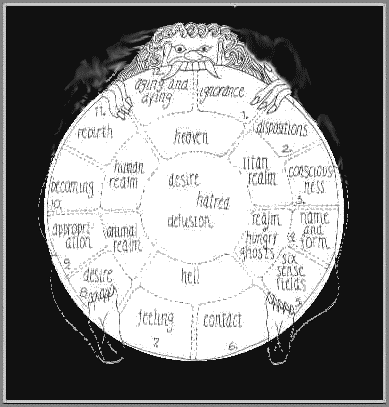
After the top realm, going in a clockwise order, next is the realm of those who, after death, are still so attached by desire to this world that they are ghosts.
In the Tibetan version, they are shown with very narrow necks and are known as ‘hungry ghosts’ because their condition prevents them from enjoying food or drink.
Take your time to explore this exhaustive site.
Copyright 1998-2006 Khandro.Net
http://www.khandro.net/doctrine_rebirth.htm
*****************************
Things found on the way
Daruma and Japanese Ghosts by Gabi Greve
*****************************
HAIKU

© PHOTO : cosumosu52.exblog.jp
六道の辻に立けりかれ尾花
roku doo no tsuji ni tachi keri kare obana
standing at the crossroad
to the Six Realms ...
withered susuki grass
Kobayashi Issa
Tr. Gabi Greve

© Haiga by Nakamura Sakuo
- - - - -
. WKD : Kobayashi Issa 小林一茶 in Edo .
- Chris Drake translates Issa :
The Six Realms ("Paths") of Karma-Bound Existence
1. Beings in Hell
yononaka wa jigoku no ue no hanami kana
-- Issa
this world --
blossom-viewing
right above hell
kore ga maa jigoku no tane ka hana ni tori
-- Kakuro
so the seeds
are from hell?
birds in the blossoms
2. Hungry Ghosts
hana chiru ya nomitaki mizu wa toogasumi
-- Issa
petals falling --
thirsty, but the only water
a misty mirage
shiranui no haru mo tachimachi kurenikeri
-- Kakuro
knowing spring's gone
from floating fireballs
that quickly flare out
3. Animals
chiru hana ni butsu to mo hou to mo shiranu kana
-- Issa
blossoms fall
but they know neither
Buddhas nor the dharma
ushi uma no nete kuu haru no no-yama kana
-- Kakuro
cows and horses
sleep and eat in spring
in fields, on mountains
4. Fierce, angry Ashura demigods
chiru hana ni tachi naginata mo kazarikeri
-- Kakuro
when blossoms fall
they get out their
swords and halberds
ana-ichi no ana kashimashi ya hana no kage
-- Issa
how noisy
the coin-tossing hole
in the shade of blossoms
[a form of gambling in which people try to toss coins into a small hole in the ground]
5. Humans
hitobito yo hana mo arashi mo uwa no sora
-- Kakuro
people, look!
at the blossoms
and the hard wind
saku hana no naka ni ugomeku shujou kana
-- Issa
sentient beings
who squirm around amid
blossoms in bloom
["amid" may be "inside"]
6. Heavenly beings
kasumu hi ya sazo tennin no gotaikutsu
-- Issa
hazy days --
the heavenly beings
must be quite bored
nagaki hi to omou hodo nao kureyasushi
-- Kakuro
the longer the days
seem, the earlier
they end
This series of hokku was written jointly by Issa and his friend Kakurou (鶴老), the head priest at Sairinji, a Tendai-school Buddhist temple twenty miles northeast of Edo. The series appears in the Kabu-ban collection of various renku, hokku, and haibun writing by Issa and his friends from 1812. In the collection the present series of hokku follows the renku kasen that begins with Issa's hokku
松蔭に寝てくふ六十よ州かな
matsukage ni nete kuu rokujuu yo shuu kana
sleeping and eating
in pine shade -- more than
sixty provinces
The present hokku series was evidently written while the cherries were blossoming in the second month, and it takes as its theme the basic Buddhist notion of six paths or realms of existence within which beings are subject to karmic reincarnation. Even heavenly beings, mostly Hindu gods who became supporters and protectors of Buddhism, have not yet achieved enlightenment and may fall back into lower realms if they forget or become indifferent to the moral laws of the universe. The number of realms is often expanded to ten, but Issa and Kakuro write about the basic six.
It's interesting that none of the hokku are otherworldly and that both poets take the present world as their starting point and seem to view the various Buddhist hells as modes of being into which living beings can fall. Various readings can be made of each hokku, so for the moment, at least, only translations are given. Readers may also be interested in the way the hokku seem to refer and reply to each other, with some even repeating words used in nearby hokku. This series of hokku is obviously not proceeding by renku rules, but it is definitely structured and echoic. Perhaps Issa and Kakuro are investigating the karma that brought them together so fruitfully.
Chris Drake
. anaichi, ana-ichi 穴一 coin-trowing game .
:::::::::::::::::::::::::::::::::::::::::::::::::::::::::::::::::::::::::::::::::::::::::::::::::::::
百方に餓鬼うづくまる除夜の鐘
hyappoo ni gaki uzukumaru joya no kane
temple bells at New Year's Eve -
hungry ghosts are squatting
in all directions
Tr. Gabi Greve
. Ishida Hakyo, 石田波郷 1913-1969 .
:::::::::::::::::::::::::::::::::::::::::::::::::::::::::::::::::::::::::::::::::::::::::::::::::::::
六道の辻で夜桜と目が合う
rokudoo no tsuji de yozakura to me ni au
at the crossroad to the six realms
my eyes meet
cherry blossoms at night
Tr. Gabi Greve
Yasunobu Nakamura
http://www.geocities.co.jp/Hollywood/3151/haiku.html
:::::::::::::::::::::::::::::::::::::::::::::::::::::::::::::::::::::::::::::::::::::::::::::::::::::
Rotting cadaver
Earth death. Meat for hungry ghosts
Maggots dance with life.
atiguhya padma, London
http://www.online-literature.com/forums/showthread.php?t=2076
:::::::::::::::::::::::::::::::::::::::::::::::::::::::::::::::::::::::::::::::::::::::::::::::::::::

Amitabha Buddha
Reminds me to make offerings
To my hungry ghosts
- Shared by Res John Burman -
Joys of Japan, August 2012
*****************************
Related words
***** Ghosts (yookai, bakemono) and haiku
***** World Kigo Database : Saijiki of Buddhist Events
***** World Kigo Database : Bon Festival (o-bon) お盆
:::::::::::::::::::::::::::::::::::::::::::::::::::::::::::::::::::::::::::::::::::::::::::::::::::::
[ . BACK to WORLDKIGO . TOP . ]
[ . BACK to DARUMA MUSEUM TOP . ]
:::::::::::::::::::::::::::::::::::::::::::::::::::::::::::::::::::::::::::::::::::::::::::::::::::::


 Posts
Posts


14 comments:
BABA ONI
withered grassland--
once upon a time there was
a female demon...
kare susuki mukashi baba oni atta to sa
.枯すすきむかし婆々鬼あったとさ
Tr. David Lanoue
..................................
太山寺追儺式・太郎鬼
親鬼は三ツ鬼(太郎鬼・次郎鬼・婆々鬼)と呼ばれる.
最後に餅割をする。子鬼と親鬼の間には走り鬼が「走り」の所作をする。鎌倉時代建立で国宝の本堂で行われる。
http://www.hi-net.zaq.ne.jp/miwakesanti/tuinasiki.html
http://www.suma.kobe-wu.ac.jp/geinou/bunka/sairei/ten_sair.html
The three masks are here
http://www.hyogo-c.ed.jp/~rekihaku-bo/historystation/festival/popup/1-02-02.html
in scattering blossoms
Buddha and Buddhism
unknown
chiru hana ni butsu tomo nori tomo shiranu kana
ちる花に仏とも法ともしらぬ哉
by Issa, 1812
Pure Land Buddhists maintain that there are "Six Ways" of possible future life reincarnation:
(1) as a sufferer in hell, (2) as a hungry ghost, (3) as an animal, (4) as an angry demon, (5) as a human being, or (6) as an enlightened saint in the Western Paradise. This haiku is poem 3 of a six-poem series on the Six Ways.
Two versions of this series exist; one appears in the 1812 book, Kabuban, while the other was published posthumously by Issa's students in Issa hokku shuu in 1829.
Tr. David Lanoue
http://cat.xula.edu/issa/
穴一のあなかしましや花の陰
ana ichi no ana kashimashi ya hana no kage
an uproar 'round
the penny toss hole...
blossom shade
by Issa, 1812
This haiku is poem 4 of a six-poem series on the Six Ways.
Two versions of this series exist; one appears in the 1812 book, Kabuban, while the other was published posthumously by Issa's students in Issa hokku shuu in 1829.
The present haiku appears only in the original, 1812 version. Referring to a gambler's game of throwing coins into a hole, Issa suggests that the loud gamblers are like angry demons-- oblivious to the beauty of the blossoms above them.
In my essay, "At the Crossroads of Six Ways: A Haiku Buddhist Vision of Life, Death, and Everything," I stated that an unseen animal inside the hole raises the ruckus in the haiku.
I now believe that the gamblers themselves are doing this. See Modern Haiku 27, No Shinji Ogawa notes that Issa is punning with the word ana, which can mean "hole" and "indeed." Hence, ana kashimashi denotes "the hole is noisy" and also "indeed noisy."
David Lanoue
http://cat.xula.edu/issa/
たまたま石田波卿の素敵な句を、ここで発見しました。鈴木真砂女の好きな人がいますので、Gabi san の訳とともに紹介します。
Emiko Miyashita さんです。
sakuo.
naginata 薙刀 / 長刀 / 眉尖刀 Japanese halberd
Hellebarde
.
六道は眩しき道栗の花咲く
嘘子
A-Yokai-A-Day: Gaki
... snip
Lastly, there is the realm of gaki. This is commonly known in English as the realm of hungry ghosts, or by its Sankrit term, preta. These are lost spirits that didn’t have enough karma to be reborn into the animal realm, but were not bad enough to go to hell. It’s not a pleasant place. They are constantly hungry, and forced to eat excrement, blood, dirt… anything, as they try to sate their hunger. However, they can never be sated, and always suffer. A gaki is not tortured like a hell-being is, but a gaki is always suffering from the most basic life instincts, and lives its entire life in misery. Obviously, also not a good place to learn how to become a Buddha.
One question that often comes up is where do yokai fit in in all of this? Are they gaki or ashura, or something else?
Yokai are not Buddhist, and so there is no official ruling on what exactly they are. I’m sure some priests would say they exist somewhere in these realms. Certainly yurei are strongly connected with Buddhism in Japan… but yokai? Not so much. In fact, most folklorists say that yokai don’t fit in at all. They don’t live in a realm of reincarnation. Yokai live in ikai, the “otherworld,” and do not reincarnate, or maybe don’t even die. I haven’t really heard any Buddhist doctrine on yokai, except for one example:
- snip
http://matthewmeyer.net/blog/2015/10/21/a-yokai-a-day-gaki/
.
Tengudoo, tengudō 天狗道 Tengudo, the Realm of Tengu
.
A realm outside the ROKUDO six realms of existence.
.
https://kappapedia.blogspot.jp/2017/01/tengudo-tengu-do-realm.html
.
In the 地獄道 Jigokudo, the Realm of Hell, there are 8 hot and 8 cold hells. Here the Oni serve as gokusotsu 獄卒 wardens of hell to torture the dead.
.
jigoku no oni 地獄の鬼 demons of the Buddhist hell
densetsu 伝説 and their legends
.
https://gokurakuparadies.blogspot.jp/2017/04/jigoku-hell-demons-devils.html
.
丹沢・ 旧ヤビツ峠・餓鬼道伝説 Tanzawa, Yabitsu Toge pass
.
https://kappapedia.blogspot.jp/2016/01/reference-tengu-tokimoo.html
.
rokudô emaki, rokudoo emaki 六道絵巻 Rokudo Emaki - Illustrated Scrolls of the Six Paths of Rebirth
----- . . . CLICK here for Photos !
rokudoo e 六道絵 Rokudo-E -Paintings of the Six Paths
.
https://gokurakuparadies.blogspot.jp/2015/06/jigoku-e-paintings-of-hell.html
.
Niigata 新潟県 .....
白根市 Shirone town
On the 16th day of the second and tenth lunar month a 田の神まつり festival for Tanokami is held at the farm houses.
In the tenth lunar month, to see the deity off, farmers prepare wappadango ワッパダンゴ ritual rice balls and offer them placed on a bale of newly harvested rice. The Yama no Kami is seated on a zabuton 座布団 cushion on the honored seat of the irori 囲炉裏 fire place. The deity is also offered green tea.
Then the head of the house says he is going to give the tea to the gaki 餓鬼 Hungry Demons and spills it at the veranda of the room. The food offerings are now eaten by the head of the household.
.
https://japanshrinestemples.blogspot.jp/2017/08/ta-no-kami-01-regional.html
.
Legends about
meido めいど【冥土 / 冥途】 the Netherworld, nether world, underworld
.
https://gokurakuparadies.blogspot.com/2014/04/yomi-yellow-springs.html
.
Legend from Hyogo, Rokko san
Hidarugami ひだる神 the Hunger God / Hidarubo ひだるぼう
If someone walks along Mount Rokkosan, the gaki 餓鬼 hunger gods bewitched him, his hands begun to tremble and he had to sit down.
.
https://edoflourishing.blogspot.com/2019/09/tokugawa-michi-road.html
.
Post a Comment