:::::::::::::::::::::::::::::::::::::::::::::::::::::::::::::::::::::::::::::::::::::::::::::::::::::
Child, Children (kodomo)
***** Location: Japan, worldwide
***** Season: Non-seasonal Topic
***** Category: Humanity
*****************************
Explanation
The Children of the World !
There are many ways to call the, all will be included in this topic, from baby to teenager ...

source : www.jiu.ac.jp/museum
菊川英山 - すな鳥子供遊
Kikugawa Eizan Children playing along the river
Universal Children's Day on November 20
Children's Day is celebrated on various days in many places around the world, to honor children globally. It was established in 1954 to protect children working long hours in dangerous circumstances and allow all children access to an education. The UN General Assembly recommended that all countries should establish a Universal Children's Day on an "appropriate" day.
Major global variants include a Universal Children's Day on November 20, by United Nations recommendation.
© More in the WIKIPEDIA !
. Kigo Calendar - November .
:::::::::::::::::::::::::::::::::::::::::::::::::::::::::::::::::::::::::::::::::::::::::::::::::::::
child, ko 子
children, kodomo 子供、子供たち
baby, akachan, midorigo 赤ちゃん 嬰児
my child, wagako 我が子
..... ako 吾子, ago あご
suckling child 乳呑子 chinomigo, chinomi-go
grandchild, grandchildren, mago 孫
orphan 孤児 minashigo / koji
stepchild まま子 mamako
koboozu 小坊主 young boy, young monk
. haiko ningyoo 這い子人形 crawling babies art motives .
:::::::::::::::::::::::::::::::::::::::::::::::::::::::::::::::::::::::::::::::::::::::::::::::::::::

"The Life of Japanese Children"
Yurimoto Keiko
- Shared by Yoshio Kusaba -
Haiku written by Children, further LINKS !!!!! .
:::::::::::::::::::::::::::::::::::::::::::::::::::::::::::::::::::::::::::::::::::::::::::::::::::::
abandoned child 捨て子, 捨子 (sutego)
topic for haiku
猿を聞人捨子に秋の風いかに
saru o kiku hito sutego ni aki no kaze ika ni
Matsuo Basho, "Journal of Bleached Bones in a Field"
those who have heard a monkey's cry:
how about this abandoned child
in the autumn wind?
(Tr. Makoto Ueda)
a monkey shriek—
for this abandoned child,
what is the autumn wind like?
or
You who hear the monkey’s cries:
what of an abandoned child
in the autumn wind?
Reference : translations of this haiku
those who listen for the monkeys:
what of this child
in the autumn wind?
Tr. Barnhill
with further discussion of "mono no aware" .
some anonymous senryu from the Edo period
今捨てる子に ありたけの乳をのませ
捨てにゆく子に笑われて 泣き出し
拾わるる親は 闇から 手を合わせ
泣くよりもあわれ 捨て子の笑い顔
拍子木で 捨て子の股をあけてみる
捨てる子は 親父の年に 四十下
source : 興津 要:探訪 江戸川柳
*****************************
Worldwide use
Germany
Kind, Kinder, Baby, Teenager, Enkel, Enkelkind
*****************************
Things found on the way

Torii Kiyonaga
(Yodo iu koitsu wa Nippon, Ezoshi o mite yori sono guai o asobu)
Aoi's Kids' Corner - Children's Literature and Illustration Art
. Fun on Facebook .

Goshi jûdô no zu) 五子十童図 Picture of Five Children or Ten Children
by Utagawa Sadakage 歌川貞景
*****************************
HAIKU
子に飽くと申す人には花もなし
ko ni aku to moosu hito ni wa hana mo nashi
For one who says,
"I am tired of children,"
there are no blossoms.
When love is absent, cherry blossoms go unappreciated ...
Robert Aitken ... more
source : books.google.co.jp
MORE
. Matsuo Basho - Family Ties .
His Wife ? Jutei-Ni 寿貞尼
His Son ? Jirobei 二郎兵衛
His nephew Tooin 桃印 Toin
The above hokku is (most probably) for the three children of his wife.
MORE - hokku about children
. Matsuo Basho 松尾芭蕉 - Archives of the WKD .
:::::::::::::::::::::::::::::::::::::::::::::::::::::::::::::::::::::::::::::::::::::::::::::::::::::::
. WKD : Kobayashi Issa 小林一茶 .
あこが餅あこが餅とて並べけり
ako ga mochi ako ga mochi tote narabe keri
my child's rice cakes
my child's rice cakes...
all in a row
R. H. Blyth pictures the scene: A mother is making rice cakes while her child watches impatiently. To "calm his over-anxious feelings," she says, "This one is yours; this one is yours too," and so on;
A History of Haiku (Tokyo: Hokuseido, 1964) 1.373. The row of tasty cakes embodies her love.
Tr. David Lanoue
.............................................................................
小道者や手を引れつつ赤扇
ko dôsha ya te wo hitaretsutsu aka ôgi
the little pilgrim
being led by hand...
red paper fan
Visiting a Buddhist temple or Shinto shrine accompanied by a parent, the child holds a red paper fan.
Issa liked the image enough to revisit it two months later:
ko dôsha no toshi wa ikutsu zo aka ôgi
how old
is this little pilgrim?
red paper fan
Tr. David Lanoue
.............................................................................
. WKD : Kobayashi Issa 小林一茶 .
孤が手本にするや反故うちは
minashigo ga tehon ni suru ya hogu uchiwa
the orphan's
calligraphy practice book --
a wastepaper fan
Tr. and Comment from Chris Drake:
This hokku is from the 5th month (June) in 1823. Judging by its placement in Issa's diary, it's from the latter half of the month. In any case, it was written right around the time of the death of Issa's wife on 5/12. If the hokku was written after her death, Issa, as a widower, may be identifying with the orphan to a certain extent. The orphan here seems to be poor and has no formal book with examples in it to use for practicing basic calligraphy -- the kana syllabary symbols and maybe a few simple ideographs or characters. Instead, the child has to make do with copying the calligraphy brushed on an old letter or other document that has been used as part of a round, non-folding fan.
In the country many people made their own fans using recycled, previously-used paper pasted onto a round bamboo frame with a handle on it, and the old paper on the fan the orphan uses has some kind of calligraphy on it, which s/he carefully copies again and again with brush, ink, and more old paper. It's not clear who's educating and taking care of the orphan, though it may well be a relative.
.............................................................................
陽炎や 目につきまとふ 笑い顔
kagero ya me ni tsukimatou warai-gao
shimmering air?
his smiling face
always there
This hokku was written on 1/17 (Feb. 19), 1821. It appears in a haibun piece called "Grieving for Ishitaro," Ishitarou o itamu, about the death on 1/11 of his third child, a son, who had been born just over three months earlier on 10/5 in 1820. This was the third straight child who had died, and this time it was not sickness but an accident. Issa's wife had strapped the infant to her back under her outer robe while she worked -- the most common method of carrying infants -- and somehow the child became asphyxiated. Issa went almost crazy with grief, and his haibun blames his overworked wife unfairly for the infant's death, though he calms down at the end, where he places three hokku and then two waka, the last of which declares he sees his dead son even in his dreams.
The hokku above is the third and last hokku in the haibun, and the headnote to it says it was written when he prayed at his son's grave on 1/17, the seventh day after the son's death. In Japanese Buddhism, special requiem prayers for a newly dead soul are said on the 7th, 14th, 21st, 28th, 35th, 42nd, and 49th days. The first is very important, as is the last, when the prayers are believed to send the soul off toward the Pure Land, far beyond its attachments to its former existence. So on the "first seventh" Issa and his wife must have gone to the family temple for the requiem, after which they probably prayed their own prayers in front of the grave. I think the ya in the first line is more than simply a cutting word. It seems to retain its earlier sense of being a question mark as well. The shimmering Issa sees in the air resembles heat haze, yet it doesn't go away, no matter where he looks. Could the visions simply be heat haze? The question surely answers itself. His prayers at his son's grave likely include a prayer for his son's soul to soon be smiling in the Pure Land.
Chris Drake
.............................................................................

- More photos of children of Edo
かがやく江戸の子どもたち
- reference source : edococo.exblog.jp -
.............................................................................
かたみ子や母が来るとて手をたたく
katami-ko ya haha ga kuru tote te o tataku
motherless child
clapping for joy --
"mother's coming"
The headnote says this hokku was written at the time of the Bon Festival, or Returning Souls Festival, so it must refer to the 7th month (7/14-16) in 1823, the year in which Issa's wife had died on 5/12. This Bon Festival was the first time she returned as a soul to see her family during the festival, and Issa apparently told (tote) his young third son Konzaburo that his mother was coming to see them (Maruyama Kazuhiko, Kobayashi Issa, Oufuusha, 1977: 208). If it was not written then, it must have been written later as a reference to the time of the Returning Souls Festival of 1823. In any case, in the hokku Issa feels that his son, only a year and four months old, has understood his words about his mother returning, since the boy claps his hands for joy.
Issa mentions this first Returning Souls Festival in a haibun piece called "Grieving for Konzaburo," Konzaburou o itamu, written in the 5th and 7th months in 1823, and in it he mentions that at the time of the festival he traveled to meet his son, who was being cared for by a wet nurse. Around the time of his wife's death, the boy became malnourished, so Issa put him in the care of a wet nurse in another village. When Issa saw his son in the 7th month, the child was only a little better, but the boy nevertheless smiled a big smile when he saw his father. The hokku about the boy clapping presumably refers to this meeting. However, in Issa's haibun he places a different hokku at the end of this scene:
kado no chou ko ga haeba tobi haeba tobu
butterfly by the door --
the child crawls, and it flies
crawls and it flies
The hokku seems to include a prayer by Issa for his son to get well and move as freely as the butterfly that the crawling boy seems to love and want to go near. Issa's prayers were in vain, however, and Konzaburo died on 12/21 of that year, leaving Issa without his wife and with no children.
Issa remarried in 1824 but was soon divorced. Then, in the 9th month (October) of 1825, still single, he wrote an apparent revision of the earlier hokku about the child clapping and the hokku about his crawling son and the butterfly:
itoshi-go ya haha ga kuru tote haiwarau
deeply loved child
smiles as he crawls --
"mother's coming"
Issa seems to weave both of the earlier hokku together into a single hokku in which he remembers his deep love for the boy and his son's smile two years before in 1823, which seemed to show that he knew how much Issa loved him. He remembers the boy's smile as he crawled after the butterfly as an expression of joy, as was the boy's wish to fly like a butterfly. This third hokku is written two months after the Returning Souls Festival, but it is also written after the deaths of both mother and child, so in the first line Issa may also mean "deeply loved by your mother" and may therefore be imagining the souls of his wife and son meeting in the Pure Land and at last finding peace and even bliss.
Chris Drake
.............................................................................

小坊主や袂の中の蝉の声
koboozu ya tamoto no naka no semi no koe
a young boy
with cicadas singing
in his sleeves
This hokku is from the 6th month (July) of 1815, when Issa was living back in his hometown. Issa uses an affectionate phrase for a young boy, "little monk," to show he's impressed. In Issa's time parents commonly cut the hair of their boys rather short or even shaved part of their heads until they were six or seven, so "little monk" (ko-bouzu) and "little Buddhist priest" (ko-zou) were extremely common terms for little boys, although the former was generally a term of endearment or admiration and the latter tended to be used more for scolding or ordering boys around. I checked all Issa's hokku with "little monk" in them and could find only one in which the context clearly implies a young boy training to be a monk in a Buddhist temple.
In contrast, in many hokku, such as the one below from the 7th month (August) of 1818, "little monk" clearly seems to refer to an ordinary young boy:
kobouzu ga ko ni oshiekeri amanogawa
a young boy
tells the baby about
the Milky Way
The boy seems to be explaining to the baby (probably his sister or brother) in very simple language the legend behind the Tanabata Star Festival held on 7/7, in which the Weaver Woman star crosses the Milky Way to visit the Oxherd Star. Perhaps he points to the sky as he explains.
In the first hokku above, Issa sees a young boy, perhaps one of a group, who has caught several cicadas with his net or perhaps with his quick hands. He doesn't seem to have a bamboo cage. Instead, he just puts the cicadas in the deep parts of his sleeves that hang down below his elbows, baggy areas he uses as pouches. The cries of the cicadas are quite strong, so though he's small he's probably a powerful presence as he walks along. Perhaps he even gives the impression of having vestigial wings.
Chris Drake
.............................................................................

A temple koboozu 小坊主 sleeping on the big gong, with mice hopping around.
This is the painter Sesshu, who painted the mice to eat his ropes.
.............................................................................
渋柿をはむは烏のまま子哉
shibugaki wo hamu wa karasu no mamako kana
a crow eating
bitter persimmons --
must be a stepchild
susuke-gami mamako no tako to shirarekeri
mamakko ya suzumi-shigoto ni wara-tataki
take-gire de tenarai o suru mamako kana
MORE hokku about mamako, the stepchild
. Comment by Chris Drake .
.............................................................................
名月を取ってくれろと泣く子哉
meigetsu o totte kurero to naku ko kana
reach up and get me
the harvest moon
begs the crying child
Tr. Chris Drake
This autumn hokku about adults needing to learn from children first appears in the 9th month (October) of 1813 among a group of hokku Issa sent to the Edo poet Seibi for evaluation. In the same month Issa also used it as the hokku in a kasen renku sequence with the haikai poet Rogetsu (露月). The first version of this hokku, from the 8th month (September) of 1813, has "that moon" in the first line, which makes the first two lines a quotation of what the young child says. The revised version, however, changes the first line to "the harvest moon," a phrase a young child probably wouldn't use, so the revised version seems to be indirect discourse from the point of view of the observer or a parent of the child. Perhaps Issa revised the first line in order to clearly indicate that the moon the child sees is round and to increase the pathos of the hokku, since the harvest moon is thought to be the most beautiful moon of the year.
The young child may be riding on its mother's back, bound there by a strap or cloth, since Japanese mothers often carried their children on their backs even after they learned to walk. The child seems to be pointing at the beautiful moon and -- a supreme child compliment -- it now wants to touch it and perhaps even eat it like a round rice cracker. Frustrated by its short arms, and apparently ignored by its parents, the child is now in tears and begins asking them strongly to reach up with their long arms and grab it for him or her. The child's straightforward, healthy desire and naivite seems very important to Issa, and its parents' apparent realism may strike him as premature or even a form of resignation. Although adults tend to forget, they have many ways, including haikai, of holding the moon very close.
In the kasen renku sequence, the second verse by Rogetsu replies to Issa's hokku with:
ko-zeni chirabaru goza no akikaze
fall wind on a reed mat
covered with copper coins
The switch to the money-centered and prosaic world of adults is almost jarring. Rogetsu may be evoking an open-air stall selling tea to people viewing the moon. Or perhaps it sells candy or little cakes, which the parents have just bought their child, hoping to pacify it. Will the child forget about touching and eating the moon so easily? The chill on the mat, Rogetsu may be suggesting, doesn't come only from the wind. The small size and value of the copper coins scattered on the mat may further suggest what will happen to the child's imaginings and desires as it grows older.
This hokku later appears in Year of My Life in a section about Issa's daughter who died young. There the hokku is surrounded by other hokku that also stress how precious children are.
Chris Drake
. WKD : Kobayashi Issa 小林一茶 .
:::::::::::::::::::::::::::::::::::::::::::::::::::::::::::::::::::::::::::::::::::::::::::::::::::::
:::::::::::::::::::::::::::::::::::::::::::::::::::::::::::::::::::::::::::::::::::::::::::::::::::::
Spielende Kinder
auf den Eisenbahnschienen...
Grashalme zittern
psychronicon
http://www.gedichte.com/showthread.php?t=64242
children playing
on the railway tracks ...
grass is trembling
(Tr. Gabi Greve)
:::::::::::::::::::::::::::::::::::::::::::::::::::::::::::::::::::::::::::::::::::::::::::::::::::::
Hiroshima o shirazaru ko-ra yo ryuutoo-e
children --
floating lit paper lanterns
not knowing Hiroshima
Yasuhiko Shigemoto (Japan - Hiroshima)
Hiroshima Memorial Day, August 6, 1945
:::::::::::::::::::::::::::::::::::::::::::::::::::::::::::::::::::::::::::::::::::::::::::::::::::::
speech impaired kid
watching chirpy birds
laughing loudly
- Shared by Aurora Geet -
Joys of Japan, 2012
:::::::::::::::::::::::::::::::::::::::::::::::::::::::::::::::::::::::::::::::::::::::::::::::::::::
"Ako...ako!"
screams the spider
as the size 9 descends
Ako is an old word for waga ko, "my child";
I guess the spiders would have used the old words whilst we humans went onto newer words.
- Shared by Donall Dempsey -
Joys of Japan, 2012
:::::::::::::::::::::::::::::::::::::::::::::::::::::::::::::::::::::::::::::::::::::::::::::::::::::
bickering children
the weatherman predicts
the first storm of May
- Shared by Laura Becker Sherman -
WKD facebook, 2012
:::::::::::::::::::::::::::::::::::::::::::::::::::::::::::::::::::::::::::::::::::::::::::::::::::::
my grandson
teaches me to smile
September sun
- Shared by Ella Wagemakers -
Joys of Japan, September 2012
:::::::::::::::::::::::::::::::::::::::::::::::::::::::::::::::::::::::::::::::::::::::::::::::::::::

Utagawa Kuniyoshi - Kodakara Asobi 歌川国芳 -子宝遊
source : Kuniyoshi, Kodakara Asobi
- - - The Four Social Classes in Children's Games
Utagawa Kuniyoshi (1797–1861)


O-cha no ko ken hitori keiko お茶の子けん壱人けいこ

the dance moves of the Hōrai-ken (also called o-cha no ko-ken)
Utagawa Yoshifuji 歌川芳藤 (1828–1887)
..................................................................
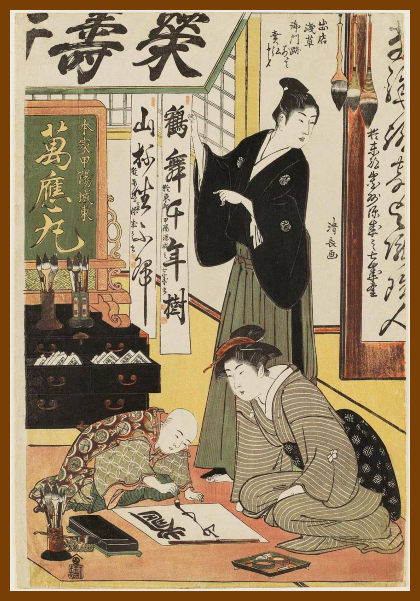
Prodigy Minamoto no Shigeyuki Executing Calligraphy
源成之の席書
*****************************
Related words
***** . kodomo no hi 子供の日 day of the children .
May 5
. nakizumoo 泣角力 crying baby sumo .
***** Mother (o-fukuro) Japan
***** Mother's Day, Father's Day
***** Chigo (temple acolytes) Japan. Temple Children

Infant's first visit to a Shinto shrine
Nishikawa Sukenobu 西川祐信 (1671-1751)
:::::::::::::::::::::::::::::::::::::::::::::::::::::::::::::::::::::::::::::::::::::::::::::::::::::
[ . BACK to DARUMA MUSEUM TOP . ]
[ . BACK to WORLDKIGO . TOP . ]
- #kodomoedo #edokodomo #edochildren- #children
:::::::::::::::::::::::::::::::::::::::::::::::::::::::::::::::::::::::::::::::::::::::::::::::::::::


 Posts
Posts


14 comments:
Hass’s “Essential Haiku” translated like this:
You’ve heard the monkey crying-
listen to this child
abandoned in the autumn wind.
How do we categorize this poem? It begins with not an observation but a reference to nature. While the child’s implied cry is compared to and has the feel of nature, it is human behavior, as is the act of abandonment committed by the child’s parents or whoever might have cared to help after they were gone.
The form of the poem, with its plea or challenge or cry of anguish, is so different from most of what we see published today.
THF / Mark Harris
http://thehaikufoundation.org/2009/08/05/3rd-sailing/comment-page-1/#comment-570
霜を着て風を敷き寝の捨子哉
shimo o kite / kaze o shikine no / sutego kana
Matsuo Basho
賎の子や稲摺りかけて月を見る
shizu no ko ya / ine suri kakete / tsuki o miru
Matsuo Basho
月十四日今宵三十九の童部
tsuki jū yokka / koyoi san jū ku no / warabe
Matsuo Basho
Kobayashi Issa
(tr. Chris Drake)
saru mo ko o oute yubisasu hotaru kana
monkey mother, too
infant on her back
points at fireflies
.
saotome ni obusatte neru kochou kana
sleeping on the back
of a woman planting rice --
a butterfly
Read the discussion :
http://groups.yahoo.com/group/translatinghaiku/message/4060
.
Kobayashi Issa
kata-atama sotte chi o nomu yuu-suzumi
head half shaved
she sucks her mother's breast
in cool twilight
Read the comment by Chris Drake
http://groups.yahoo.com/group/translatinghaiku/message/4212
.
Kobayashi Issa
子どもらが雪喰ながら湯治かな
kodomora ga yuki kui nagara tooji kana
eating snow
children cure themselves
in the spa bath
Read the comment by Chris Drake
Kobayashi Issa
乳呑子の風よけに立かがし哉
chinomi-go no kazeyoke ni tatsu kagashi kana
a scarecrow stands
shielding the suckling child
from the autumn wind
and
placing tall grass
on the ground, I kneel
say Buddha's name
hito-nembutsu mousu dake shiku susuki kana
Read the comment by Chris Drake
Matsuo Basho
Matsuo Basho
いざ子供走りありかん玉霰
iza kodomo hashiri arikan tamaarare (tama-arare)
come, children,
let’s go out and run
in the hail!
Tr. Makoto Ueda
Iza, let's go!
Kobayashi Issa
小坊主よも一ッ笑へ梅の花
ko boozu yo mo hitotsu warae ume no hana
laugh, little boy
and make another
plum blossom bloom
Tr. and read the comment by Chris Drake -
.
Kobayashi Issa
産声に降りつもりけり花と金
ubugoe ni furi tsumori keri hana to kane
flowers and gold
falling, covering the ground
as the new baby cries
This hokku is from the eleventh month (December) of 1823, a traumatic year for Issa. On lunar 5/12 his wife Kiku died of gout, and his fourth and only surviving child, his third son Konzaburo, fell very sick and died about a month after this hokku was written. The hokku contains a clear allusion to the legend that when the Buddha was born in Lumbini Grove in India fragrant flowers began falling down out of the clear blue sky. Issa's Complete Works (1.282) classifies this hokku as being about the Flower Festival held at Buddhist temples on lunar 4/8 to celebrate the Buddha's birth. At the festival a statue of the baby Buddha stands in a bowl of sweet tea under a small roof covered with flowers that together represent the flowers falling from heaven onto the newborn Buddha and the sweet rain dropped by dragons that washed the infant. However, the reference to gold goes beyond the Flower Festival, so I take Issa to be generalizing the imagery of the festival and suggesting that every birth is a very important event, since all babies are more precious than gold and possess a Buddha-nature that must be respected and even revered. In Buddhism, gold is more than a material. It is a visible symbol of invisible spiritual radiance and is therefore used in most statues and paintings of Buddhas.
In particular, Issa might be thinking especially of his frail son Konzaburo (金三郎), whose name literally means Golden Third Son, and remembering the hope he and his wife no doubt had when the boy was born that at least one of their children would live to become an adult. Konzaburo's name expresses more than a prayer for material riches. Surely Issa and his wife hoped Konzaburo would eventually become aware of the light of wisdom and compassion radiating from Amida Buddha and many other Buddhas and bodhisattvas.
However, three hokku after this one in Issa's diary is the following:
childless, I make
one bowl of sweet sake --
cold this winter
ko motazu ya hito-amazake no kan-zukuri
There are no personal pronouns in the original hokku, but it seems to be about Issa. If so, he already senses that in the real world there is little or no hope for his son Konzaburo and that before the winter ends the boy will probably be gone, leaving him as the sole survivor in his family. Or perhaps he still has a little hope for his son, although the infant boy is being suckled by a wet nurse and is too weak to drink sweet sake now. Sweet sake is a low- or non-alcoholic drink made from the dregs of sake or from fermented rice, often with a little sugar added. It was and is often enjoyed warm at the end of the year by whole families, but Issa makes only enough for one person.
Chris Drake
.
Introducing
International Library of Children's Literature,
part of the National Diet Library system
(... letting school children experience rare books in university libraries and prefecture libraries)
.
http://www.kodomo.go.jp/info/child/2015/2015-040.html
.
子供あそびさつきの戯 Kodomo asobi satsuki no tawamure
Children's play in May
.
https://ukiyo-e.org/image/harashobo/15741_3
.
The Seventh Night’ nanayo 七夜
This is a reference to the seventh night after a child was born,
which was when celebrations were held for its long life.
.
Post a Comment