3/14/2011

Suzuki Masajo

[ . BACK to Worldkigo TOP . ]
:::::::::::::::::::::::::::::::::::::::::::::::::::::::::::::::::::::::::::::::::::::::::::::::::::::
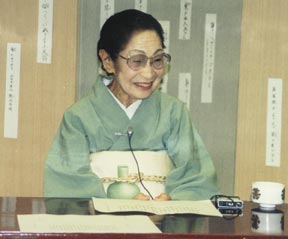
Suzuki Masajo (1906-2003)

鈴木真砂女 (すずきまさじょ)


明治39年-平成15年) 平成15年3月14日

Masajo Suzuki

. Reference .


Suzuki Masajo, author of
Love Haiku: Masajo Suzuki's Lifetime of Love,
has died.

Emiko Miyashita, a well-known haiku poet and a translator of Suzuki Masajo, wrote:

"I went to Masajo's wake this evening.. The wake was held in Gokokuji Temple in Tokyo from 6:00 p.m.This is her alter. All the attendants offered a white chrysanthemumn to this extraordinary lady who had lived her life so fully...."
source : www.hsa-haiku.org


:::::::::::::::::::::::::::::::::::::::::::::::::::::::::::::::::::::::::::::::::::::::::::::::::::::


Last Farewells to Masajo
-- A Life of Love and Haiku

Susumu Takiguchi, Oxford, England

One of the most distinguished and best loved haiku poets, Suzuki Masajo (1906-2003), has passed away. She was 96. She died a natural death peacefully at a retirement home in Tokyo
on Friday 14 March 2003. Her life was one of love and haiku, which is chronicled in her own unforgettable poems and essays.

Masajo was a successful business woman and restaurateur, beside being a poet. She ran the famous watering place in Ginza, Tokyo, called "Unami", of which she took personal charge every day until she was 90. Born nearly a century ago into an old family of hoteliers in Chiba, dating back to the Edo Era (1603-1867), she lived a life comparable to those of heroines in operas such as La Traviata or Tosca. Her first husband "disappeared". Her elder sister, who inherited the inn business, suddenly died. Masajo took over the family business and married the sister's husband. They had a troubled married life from which she "walked out" to start her own new life in Tokyo at 50.

She opened Unami and then her business and career as a haijin went from strength to strength, blooming and flowering even more beautifully every passing year. She made friends with some of the most famous writers and celebrities, was adored by them and became the heroin of at least two best-selling novels, one by Niwa Fumio and the other by Setouchi Jakucho. Incredibly, she never lost her humility and personality to put other people's interest first.

Her haiku teachers included Kubota Mantaro and Anju Atsushi. They must have had an easy time as she was a born poet and a natural haijin and above all her life itself was poetry. Copies of her anthologies such as "Yu-botaru" (evening fireflies, 1976) and "Shi-Mokuren" (purple magnolia, 1999) are treasured by her ever-increasing fans as something more than haiku books.

Her haiku poems follow traditional Japanese lines in form, style and themes. However, these are mere stage sets. The content, impact and originality have come from her life itself. She was one of the best "actresses of life", where poetry, nature, human existence and events were all one. This is partly because she lived through one of the most dramatic times in Japanese history. As such, her haiku poems are rich and deep, ranging from despair and sadness to the rupture of sensual pleasure, from macabre tales to the lightest touch of humour.

haku-to ni hito sasu gotoku ha wo ire-te

pushing the knife
into white peach's flesh
as if to stab someone

kon-jo no ima ga shiawase kinu-katsugi

this life of mine
now is my happiness --
boiling taro

Her love poems are too numerous to quote. Having been born and brought up along a coast, the sea was her "home" and waves were one of her frequently favoured themes, whether they were waves of the sea or waves of the vicissitudes of life. The name of her small restaurant, "Unami", means summer waves. Masajo of course knew that one was born and died but she also believed in the eternity of things. The transitory and the permanent lived happily together within her. As someone who is fortunate enough to have been given a tiny sliver of friendship by this most generous of the generous hearts, I humbly wish to offer the following to Masajo, people's eternal love:

izuku nite kurasu mo natsu no nami-gashira

wheresoever
one happens to live --
summer white horses


FIRE, BEAUTY AND HAIKU
Life, Love and Poetry of Suzuki Masajo
Susumu Takiguchi

Part Two got lost with the WHR archives ...


:::::::::::::::::::::::::::::::::::::::::::::::::::::::::::::::::::::::::::::::::::::::::::::::::::::


firefly light:
I step off the path
of woman's virtue


Masajo Suzuki followed her own path. She is not just a love poet in the sense of writing about her lover, but a love poet in the larger sense of loving life and living it fully.


"Inspired by a love story we heard at the Haiku North America conference at Evanston, Illinois in the summer of 1999, we began translating Masajo's haiku. This book contains 150 love haiku selected from the 2,576 haiku in her seven haiku books published between 1955 and 1998. We hope they will touch your hearts as they have touched ours."


梅青し女のもてる悪だくみ
ume aoshi onna no moteru warudakumi

plums so green
a woman embracing
a malicious design


Lee Gurga & Emiko Miyashita
Lincoln, IL (USA) & Kawasaki, Japan

© 2004 Randy Brooks
http://www.brooksbookshaiku.com/translations/masajolovehaiku.html


- Haiga by Nakamura Sakuo -

:::::::::::::::::::::::::::::::::::::::::::::::::::::::::::::::::::::::::::::::::::::::::::::::::::::


春塵や東京はわが死にどころ 
shunjin ya Tookyoo wa waga shinidokoro  

spring dust -
Tokyo is the place
of my death

Tr. Gabi Greve


:::::::::::::::::::::::::::::::::::::::::::::::::::::::::::::::::::::::::::::::::::::::::::::::::::::


人は盗めど ものは盗まず 簾巻く
hito wa nusumedo mono wa nusumazu sudare maku

I may have stolen men,
but I have never stolen a thing
winding up the rattan blind

1973, Masajo (Tr. Susumu Takiguchi)

xxxxxxxxxxxxxxxxxxxxxxxxxxxxx

I have stolen a man
but never a thing of value
I roll up the bamboo blind

Tr. Lee Gurga and Miyashita Emiko
"The British Museum Haiku" edited by David Cobb
(the British Museum Press, London, 2006)


xxxxxxxxxxxxxxxxxxxxxxxxxxxxx


"Rolling up the bamboo blind"
may suggest the aftermath of a night of love. A court lady rolling up a bamboo blind on a snowy landscape is a classic subject going back to a poem by Po Chu-i.

Bamboo blinds also figure prominently in The Tale of Genji and The Pillow Book of Lady Sei Shonagon. Suzuki Masajo may be making an allusion to classic Japanese literature.

Larry Bole, Translating Haiku


:::::::::::::::::::::::::::::::::::::::::::::::::::::::::::::::::::::::::::::::::::::::::::::::::::::


白玉や愛す人にも嘘ついて
shiratama ya aisu hito ni mo uso tsuite

sweet rice dumplings---
even to my love
a little white lie
Tr. Lee and Emiko


. WASHOKU
Shiratama, white dumplings


:::::::::::::::::::::::::::::::::::::::::::::::::::::::::::::::::::::::::::::::::::::::::::::::::::::


BACK TO
Introducing Japanese Haiku Poets


[ . BACK to WORLDKIGO . TOP . ]
::::::::::::::::::::::::::::::::::::::::::::::::::::::::::::::::::::::::::::::::::::::::::::::::::::: 

3/04/2011

Haiku in the US

[ . BACK to WORLDKIGO TOP . ]
:::::::::::::::::::::::::::::::::::::::::::::::::::::::::::::::::::::::::::::::::::::::::::::::::::::

Haiku in the US

Some thoughts by Jim Wilson
February 2011

I want to suggest that there are two haiku worlds in the U.S.
The first is a kind of 'official' haiku world. It is the world of the HSA and Northern California Haiku Poets, and other local Haiku organizations. They tend to be small but dedicated.

With the significant exception of Yuki Teiki, they all tend to advocate for free verse haiku. It is in this sense that I meant that American Haiku has become a type of free verse; that is to say that official, or organizational, American Haiku has become a type of free verse.

Outside of the context of official haiku organizations there is another type of haiku. It is not organized; that is to say it doesn't have any official organization advocating for its point of view. That's not unusual; there's no official organization advocating for an approach to the villanelle or the sestina. Haiku poets in this other, non-official, group tend to write syllabic haiku rather than free verse. They tend to approach haiku in the same way that a cinquain poet would approach cinquain. I mean that the syllable count and lineation are the starting points.

When I have communicated with this second group what I have learned is that they are aware that their approach differs from what something like the HSA advocates, but they nevertheless find a syllabic approach fruitful, often saying it 'works' for them. And so they continue.

What I am wondering, or suggesting, is that this second group is more extensive than at first one might guess. As I posted above, if one goes by publications, then the poets who write syllabic haiku are very active. I don't know how one would go about comparing quantity, but two free verse haiku poets (one of whom is very well known) have said to me that they suspect the majority of haiku written in the U.S. are syllabic. Again, this is a guess, but it is an informed one.

In my opinion the two types have become different forms of poetry.
For example, it would make sense to me to have a separate forum here at Aha for 'syllabic haiku' in the section where Jane has cinquain. The reason I think they have become distinct forms is because they have developed different standards of judgment.

The free verse haijin values succinctness, terseness, and a kind of rapid-fire minimalist syntax. The syllabic haijin tend to compose in a syntax that is more like common speech, often mimicking ordinary, overheard, conversations or even directly quoting from those and other sources like song.

From the free verse haijin's perspective the syllabic haijin is 'wordy' and 'padding'.
But from the syllabic haijin's perspective they are just being 'natural'.

From the syllabic haijin's perspective free verse haiku are often truncated and lack flow.
From the free verse haijin's perspective 'less is more'.

In other words, I'm tentatively suggesting that the two approaches have grown up and they have matured into differentiated poetic forms. Though they share the same name, 'haiku', they are composing differently, using different standards, and I believe as the years go by these differences will become greater and more apparent.

I don't think this is to be regretted.
But I believe recognizing this could prove helpful to all concerned.

Jim Wilson


Shaping words

Shaping Words is dedicated to the exploration of formal syllabic verse in English.
www.shapingwords.blogspot.com


::::::::::::::::::::::::::::::::::::::::::::::::::::::::::::::::::::::::::::::::::::::::::::::::::::: 


. Definitions of Haiku .  


[ . BACK to WORLDKIGO  TOP . ]
[ . BACK to DARUMA MUSEUM TOP . ]

::::::::::::::::::::::::::::::::::::::::::::::::::::::::::::::::::::::::::::::::::::::::::::::::::::: 

3/02/2011

Prayer flag, prayer flags

[ . BACK to WORLDKIGO TOP . ]
:::::::::::::::::::::::::::::::::::::::::::::::::::::::::::::::::::::::::::::::::::::::::::::::::::::

Prayer flag, prayer flags

***** Location: Japan, Tibet
***** Season: Non-seasonal Topic
***** Category: Humanity


*****************************
Explanation


CLICK for more photos

A prayer flag is a colorful panel of rectangular cloth, often found strung along mountain ridges and peaks high in the Himalayas. They are used to bless the surrounding countryside and for other purposes. Prayer flags are believed to have originated with Bön, which predated Buddhism in Tibet. In Bön, shamanistic Bonpo used primary-colored plain flags in healing ceremonies. They are unknown in other branches of Buddhism.
Traditionally they are woodblock-printed with texts and images.

The Indian Buddhist Sutras, written on cloth in India, were transmitted to other regions of the world. These sutras, written on banners, were the origin of prayer flags.
© More in the WIKIPEDIA !


:::::::::::::::::::::::::::::::::::::::::::::::::::::::::::::::::::::::::::::::::::::::::::::::::::::


Prayer flags can be associated with a lot of things, that is the personal and cultural bias of each individual born into a certain cultural environment.

The World Kigo Database tries to explain the different cultural aspects of items that YOU (each one of you) find worthy to write a haiku about.

We should be proud of our different cultures and happy to explain it to our haiku friends worldwide. That is at least my effort with the database.
Please contribute your cultural heritage through haiku !

Gabi Greve

*****************************
Worldwide use


:::::::::::::::::::::::::::::::::::::::::::::::::::::::::::::::::::::::::::::::::::::::::::::::::::::


Tibetan Prayer Flags

The flags are made in colors representing the five elements of the universe:

Blue is the sky
White is for the clouds
Red is fire
Green is water
Yellow is the earth


:::::::::::::::::::::::::::::::::::::::::::::::::::::::::::::::::::::::::::::::::::::::::::::::::::::


. . Japanese Prayer Flags in Five Colors
(goshiki ban 五色幡)   
 
ban 幡(ばん)doo 幢, hata 旗, dooban 幢幡(どうばん)


*****************************
Things found on the way


holding out
in the winter sky -
last cherry leaf


This leaf reminds me that things happen in nature
without our "willing" it.
When it is time, it will fall, no sooner, no later.

It is my teacher on the path of life and death.
It is my prayer flag.


. Gabi Greve, Winter 2009


*****************************
HAIKU


prayer flags -
in thin air
trembling lips in worship

Gabi Greve
McLeoud Ganj, Indian Himalayas, 1979

. Himalaya Mountains, India  


. . . . .


moving wind
moving flag
moving mind


Zen Koan and
Prayer Flags in Bhutan


. . . . .


prayer flags
the old pine swayes
unmoved

Trees and Prayer Flags in Japan

Gabi Greve


:::::::::::::::::::::::::::::::::::::::::::::::::::::::::::::::::::::::::::::::::::::::::::::::::::::


first snow . . .
Tibetan prayer flags flapping
in the wind

richard kay
Australia


:::::::::::::::::::::::::::::::::::::::::::::::::::::::::::::::::::::::::::::::::::::::::::::::::::::


Tibetan Plateau
faded prayer flags flutter
in the autumn wind

Chen-ou Liu
Canada


:::::::::::::::::::::::::::::::::::::::::::::::::::::::::::::::::::::::::::::::::::::::::::::::::::::

see happiness
in prayer flags...
snow on the mountain


Shared by Pat Geyer
Joys of Japan, February 2012


*****************************
Related words


***** Faith and Prayer

. WKD - LIST of haiku topics and Keywords  

::::::::::::::::::::::::::::::::::::::::::::::::::::::::::::::::::::::::::::::::::::::::::::::::::::: 


The word FLAG (hata) just like that is not a kigo.

There are many different kinds of flags, some toys,
some important like the "national flag".

They can be used at any time of the year.


. Tomobata matsuri 伴旗祭 (ともばたまつり)
Tomobata Flag Festival .

April 17 and 18


:::::::::::::::::::::::::::::::::::::::::::::::::::::::::::::::::::::::::::::::::::::::::::::::::::::


Tibet and Daruma


[ . BACK to WORLDKIGO  TOP . ]
[ . BACK to DARUMA MUSEUM TOP . ]

:::::::::::::::::::::::::::::::::::::::::::::::::::::::::::::::::::::::::::::::::::::::::::::::::::::