[ . BACK to WORLDKIGO . TOP . ]
:::::::::::::::::::::::::::::::::::::::::::::::::::::::::::::::::::::::::::::::::::::::::::::::::::::
Kikaku Takarai Kikaku 宝井其角
Enomoto Kikaku (1661-1707)
寛文元年7月17日(1661年8月11日) -
宝永4年2月30日( 一説には2月29日)(1707年4月2日))
a Japanese haikai poet and among the most accomplished disciples of Matsuo Bashō. His father was an Edo doctor, but Kikaku chose to become a professional haikai poet rather than follow in his footsteps.
One day, Kikaku composed a haiku,
Red dragonfly / break off it wings / Sour cherry
which Bashō changed to,
Sour cherry / add wings to it / Red dragonfly
鐘ひとつ賣れぬ日はなし江戸の春
kane hitotsu urenu hi wa nashi Edo no haru
Springtime in Edo,
Not a day passes without
A temple bell sold.
© More in the WIKIPEDIA !
. Enomoto Kikaku Takarai ... MAIN ENTRY
for 是橘
Zekitsu, see below.
:::::::::::::::::::::::::::::::::::::::::::::::::::::::::::::::::::::::::::::::::::::::::::::::::::::
.................. Original Japanese
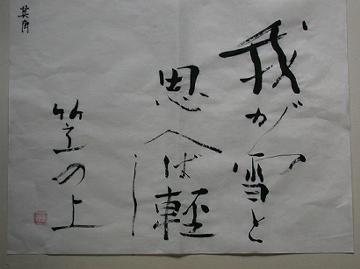 「我が雪と思えば軽し笠の上」
waga yuki to omoeba karushi kasa no ue
其角は
「我がものと思えば軽し傘の雪」
waga mono to omoeba karushi kasa no yuki
と2つ詠んだそうです。
Kikaku wrote these two versions.
http://araraoasys.web.infoseek.co.jp/oashp/youtisyodoukan.htm
ooo ooo ooo ooo ooo ooo ooo ooo ooo
わが雪と思えばよろし傘の上
waga yuki to omoeba yoroshi kasa no ue
其角 Kikaku
http://naojiro.at.webry.info/200512/article_1.html
http://www.tsukiji.or.jp/nikki/9907/9907.html
我が雪と思えば軽し笠のうへ
宝井其角 Takarai Kikaku
blog.livedoor.jp/kokorozawazawa/
waga yuki to omoeba karushi kasa no ue
Kikaku Takarai (1661-1705)
www.mcedit.com/archive/Wingspan/2004/December/CSP.html
:::::::::::::::::::::::::::::::::::::::::::::::::::::::::::::::::::::::::::::::::::::::::::::::::::::
"It's mine," I think . . .
and the snow seems lighter
on my straw hat.
waga yuki to / omoeba
karoshi / kasa no ue
by Mukai Kyorai
Translated by Steven D. Carter
ooo ooo ooo
This snow is mine
thinking that way it seems lighter
on your sedge hat
Kikaku (1661-1707)
Translated by Michael K. Bourdaghs
http://groups.yahoo.com/group/simply_haiku/message/14454
ooo ooo ooo ooo ooo ooo ooo ooo ooo
In Russian
Это мой собственный снег!
Каким он кажется легким
На плетеной шляпе моей!
This translation of Kikaku is published in
Matsuo Basho : The great in the small,
St. Petersburg "Tertsiia" 1999.
............... and this version
from: One Hundred Famous HAIKU
Selected and translated into English by Daniel C. Buchanan
Japan Publications, INC
Tokyo and San Francisco 1973
ISBN 0-87040-222-6
page 115
Waga yuki to
Omoeba, karoshi
Kasa no ue.
--Kikaku
When I think of it
As my snow, how light it is
On my bamboo hat.
Composed by the poet on seeing a picture of
Su Tong P'o, a famous Chinese literary figure, wearing a large hat covered with snow.
The general meaning -- what is our own never seems burdensome.

In the above text, the kanji for 軽し is read KAROSHI .
(Contributed by Natalia Rudychev)
ooo ooo ooo ooo ooo ooo ooo ooo ooo
if I think the snow mine
my hat
becomes light
Enomoto Kikaku (1661-1707)
Tr. by DR. MICHAEL HALDANE
http://www.michaelhaldane.com/HaikuNonJapanese.htm
:::::::::::::::::::::::::::::::::::::::::::::::::::::::::::::::::::::::::::::::::::::::::::::::::::::
More English versions, collected by Larry
When I think it is my snow
On my hat,
It seems light.
--Blyth, (Haiku, Vol. 4, pp. 250-51)
Blyth then makes a tedious comparison to a Chekov story about a stray dog. He sums up his comments with an unattributed quote from Milton:
The mind is its own place, and in itself
Can make a heavan of hell, a hell of heaven.
Blyth then says:
"Shiki rightly says that it must be [written Japanese] 'When I think it is my snow.'
"As a haiku, the poetry lies in the intimate feeling of ownership by the poet of the snow which is on his own umbrella, but the verse lends itself to generalization so easily that it cannot be called a good one."
..... ..... .....
This snow is mine
thinking that way it seems lighter
on your sedge hat
Tr. Bourdaghs
"It's mine," I think . . .
and the snow seems lighter
on my straw hat.
Tr. Carter
if I think the snow mine
my hat
becomes light
Tr. Haldane
Waga yuki to omoeba karushi kasa-no ue
My snow thus when-think is-light straw-hat's top
"My snow!"--when I think that,
it weighs almost nothing
on my umbrella-hat!
Tr. Henderson "An Introduction to Haiku."
"It's my snow"
I think
And the weight on my hat lightens
Tr. Kerr, "Lost Japan."
Think it's your snow, and it's light on your hat
Tr. Sato, "From the Country of Eight Islands."
Collected by Larry
And more is here
With Annotations, collected by Larry
:::::::::::::::::::::::::::::::::::::::::::::::::::::::::::::::::::::::::::::::::::::::::::::::::::::
Here are my attempts to express the haiku's idea.
Think of the snow on your hat
as a belonging,
and it'll feel weightless.
When I think the snow
on my hat is my belonging,
it seems weightless.
Zhanna P. Rader
translatinghaiku/message/135
xxxxxxxxxxxxxxxxxxxxxxxxxxxxx
it's quite light
when I think it's mine --
snow on my hat
Grzegorz Sionkowski"
translatinghaiku/message/198
xxxxxxxxxxxxxxxxxxxxxxxxxxxxx
The conical shape of the Japanese straw hat calls to mind a mountain, thus the hat covered with snow looks like a mountain covered with snow, which enhances the feeling of burden to the person wearing it.
So when they think of it as their own hat, that helps to lighten their burden, but if they think of the 'mountain' of the imagery as belonging to them, then they must feel like a lord!
The verse below is not really a translation, but a verse that expresses the feeling I get from this poem.
my own mountain!
this snow-covered hat
~ translatinghaiku/Kei~
:::::::::::::::::::::::::::::::::::::::::::::::::::::::::::::::::::::::::::::::::::::::::::::::::::::
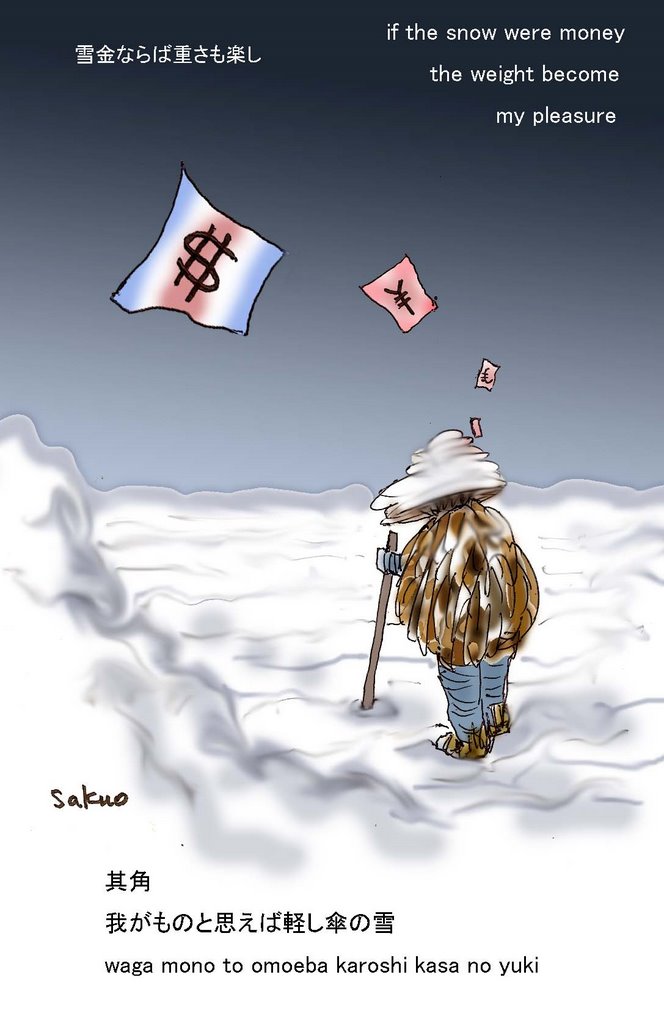
Renku from Sakuo Nakamura
雪が金なら 重さも楽し
yuki ga kane nara omosa mo tanoshi
if the snow were money
the weight becomes my pleasure
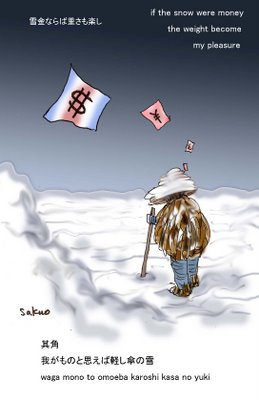 ISSA Haiga by Nakamura Sakuo
:::::::::::::::::::::::::::::::::::::::::::::::::::::::::::::::::::::::::::::::::::::::::::::::::::::
傘の雪 Kasa no Yuki, snow on the Umbrella, in Old Edo
江戸言葉で自分の物にしたいことを”傘の雪”と言う.
In the language of Old Edo, the expression
"kasa no yuki" "snow on my umbrella" was used to indicate something that you would like to have, to posess.
http://www15.tok2.com/home/waon/hauta/hauta22.htm
我がものと思えば軽し 笠の雪。
これは宝井其角という俳人の句だが、彼の詠むとおり、俳諧というのも笠の上の雪に同じ。
http://www003.upp.so-net.ne.jp/p-para/gehou/gehou10_11.htm
蓑は、まだ着てみたためしはありませんが、
笠は、着けて歩いたためしはあります。
思っているより笠の直径って大きく出来ていて、肩のあたりまで屋根をつくってくれるので、雨とかは結構だいじょぶでした。
ただ、雪の場合、笠の上に雪がつもってくると、歌沢ぶしの「
わがものと思えば軽き傘の雪」とは違って 直接頭に重みかかってくるだけに、重たいですけどね…。
A straw hat was rather large and covered also the shoulders, so if snow piled up on it, it must have been quite heavy、since it was right on your head. On an umbrella, it might feel different.
http://www.kwai.org/modules/weblog/details.php?blog_id=90
.. .. ..
市人よこの笠売らう雪の傘
ichibito yo kono kasa uroo
yuki no kasa
market-shoppers!
let me sell you this hat
full of snow
Tr. Shirane
Read more on our discussion about the snow on my hat !
MORE Hokku about his hat :
. Matsuo Basho 松尾芭蕉 - Archives of the WKD .
:::::::::::::::::::::::::::::::::::::::::::::::::::::::::::::::::::::::::::::::::::::::::::::::::::::
Various Questions arise from the above:
Who wrote this haiku ?
Writing in Romaji:
Is the original KAROSHI or KARUSHI or YOROSHI ?
If the original is YOROSHI, why translate it as LIGHT ?
KASA :
1
笠 :
straw hat, sedge hat, bamboo hat
2
傘 ..: umbrella (made from oiled paper in the Edo Period)
 Umbrella, a kigo
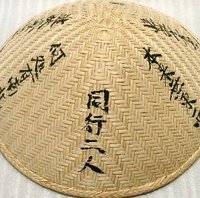 KASA the straw hat of this discussion,
with illustrations in detail
Read more about this problem here:
Translating Haiku # 122
:::::::::::::::::::::::::::::::::::::::::::::::::::::::::::::::::::::::::::::::::::::::::::::::::::::
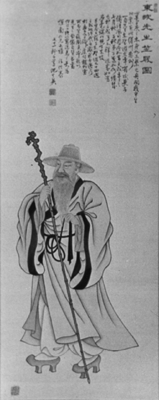
Su Tung Po (Su Dong Po, Su Tong Po) 蘇東坡
1037 - 1101 (1036-1100) , China
He he wrote very simple poems based on Buddhist Philosophy.

Painting by Chi Un-Yeong (1853-1936) of the famous 11th-century
Chinese scholar-poet Su Dong-Po, in straw hat and wooden shoes.
http://www.columbia.edu/cu/record/archives/vol21/vol21_iss29/record2129.23.html
......................................... Remembrance
To what can our life on earth be likened?
To a flock of geese,
alighting on the snow.
Sometimes leaving a trace of their passage.
www.poemhunter.com/su-tung-po/poet-38991/
His famous poem, Battle of Red Cliff
www.poemhunter.com/su-tung-po/poet-38991/
Read an amusing koan about BUDDHA AND COW DUNG
http://www.purifymind.com/CowDung.htm
:::::::::::::::::::::::::::::::::::::::::::::::::::::::::::::::::::::::::::::::::::::::::::::::::::::::
Matsuo Basho at the New Year haikai meeting with Kikaku
in 1686 貞亨3年
月雪とのさばりけらし年の暮
tsuki yuki to nosabari kerashi toshi no kure
“moon and snow”:
so I’ve indulged myself
to the end of the year
nosabaru implies an arrogant indifference to others, making this one of Basho's periodic self-depracations.
Tr. and comment Barnhill
Kikaku had written this hokku
気晴ては虹立空かよもの春
:::::::::::::::::::::::::::::::::::::::::::::::::::::::::::::::::::::::::::::::::::::::::::::::::::::
:::::::::::::::::::::::::::::::::::::::::::::::::::::::::::::::::::::::::::::::::::::::::::::::::::::
Kobayashi Issa 小林一茶
29th day - rain
requiem for Kikaku on the hundredth anniversary of his death
春の風草にも酒を呑すべし
haru no kaze kusa ni mo sake o nomasubeshi
spring wind --
let us share our sake
with the grass
This hokku was written in Edo on 2/29 (early April) in 1806 and is immediately preceded in Issa's diary by the diary note translated above the hokku. Takarai Kikaku was one of the leading hokku and renku poets of the 17th century. He was the most talented of Basho's followers -- so talented that he struck out on his own path after a few years. He was born in Edo, had an urban sensibility, and wrote very worldly and often warmly humorous hokku that are still widely read today. He was very popular in Edo because of his love for the common things of the floating world, and during his life he was probably more popular there than Basho, who spent a lot of his time away from Edo. Kikaku was also famous as a heavy drinker, and he eventually killed himself with his drinking, dying at age 47 in 1707.
He died on 2/29 (some say 2/30), and his last hokku, which began a renku sequence, was written on 2/23:
uguisu no akatsuki samushi kirigirisu
bush warbler
cold at dawn --
a cricket
Although it is spring in the hokku, some of the dawns, such as this one, are still cold. The bush warbler's songs also seem cold, a coldness accentuated by the weak cry of an autumn cricket which has managed to survive the winter but which now sounds very feeble. This hokku is often said to express Kikaku's feeling that he was about to die, as if he were here comparing himself to the weak cricket. Certainly he is sympathizing with the cricket.
Issa, who learned haikai in Edo, deeply respected Kikaku, wrote about him, and regarded him as a poet next only to Basho in ability, and he must have taken the hundredth anniversary of Kikaku's death very seriously. It is also an important anniversary in Buddhism, so Issa must have made a prayer for Kikaku's soul on 2/29. In fact, the diary entry at the head of the hokku may mean that Issa visited Shououin Temple in Asakusa, a Pure Land temple within which Kikaku's grave was located, in order to attend the hundredth-year requiem there. Issa often visited Asakusa, and, given his respect for Kikaku, he is likely to have attended the requiem service.
Asakusa has many places to eat and drink, and perhaps Issa later joined a post-requiem drinking get-together/memorial wake. Since it rained on this day, the grass was probably wet, so the drinking was likely inside. Perhaps Issa's hokku was a suggestion to those thinking of Kikaku at that time that they share their sake with the grass and symbolically with sake-loving Kikaku's soul. A warm spring wind was blowing, probably making some long grass nearby bend and sway, so perhaps Issa felt as if Kikaku's spirit might almost be about to appear. Or at least that might have been his wish.
The requiem is only 99 years after Kikaku's death by western counting, but in Japanese Buddhism the year of death was and still is counted as one year, so 1806 was the hundredth anniversary year for someone who had died in 1707.
Chris Drake
*****************************
Related words
*****
Hat (kasa) 笠いろいろ
*****
. Enomoto Shidoo 槐本之道 Shido .
Tookoo - 東湖 - Toko "East Lake"
(1659?−1708)
:::::::::::::::::::::::::::::::::::::::::::::::::::::::::::::::::::::::::::::::::::::::::::::::::::::
Zekitsu 是橘
He was a hokku disciple of Kikaku since about 1689, and then choose to become a doctor and study with the father of Kikaku. On that day he had his hair cut.
His name was Choosuke 長助 Chosuke, but many called him Korekichi 是吉.
He later became a surgeon and called himself Uzawa Chooan 鵜沢長庵 Uzawa Choan.
Uzawa Zekitsu 鵜沢是橘 (うざわ ぜきつ)
Basho wrote this auspicious hokku for him.
初午に狐の剃りし頭哉
はつむまに 狐のそりし 頭哉
hatsu-uma ni kitsune no sorishi atama kana
hatsumuma ni
on the first day of the horse
a fox has shaved
your head, it seems . . .
Written in 元禄6年, Basho age 50.
This hokku is full of gentle humour and also auspicious for the occasion.
The cut marker KANA is at the end of line 3.
. WKD : first day of the horse, hatsu uma 初午 .
a festive day at the Inari Fox Shrines of Edo. Farmers prayed for a good harvest on this festival, later the merchants prayed for good business.
The first day of the horse in the second lunar month.
 source : turbobf1516
:::::::::::::::::::::::::::::::::::::::::::::::::::::::::::::::::::::::::::::::::::::::::::::::::::::
[ . BACK to WORLDKIGO . TOP . ]
[ . BACK to DARUMA MUSEUM TOP . ]
:::::::::::::::::::::::::::::::::::::::::::::::::::::::::::::::::::::::::::::::::::::::::::::::::::::






 Posts
Posts


